From Satellite to Mailbox: How Agentic AI Is Closing $50K+ Deals on Autopilot
April 10, 2026
TL;DR
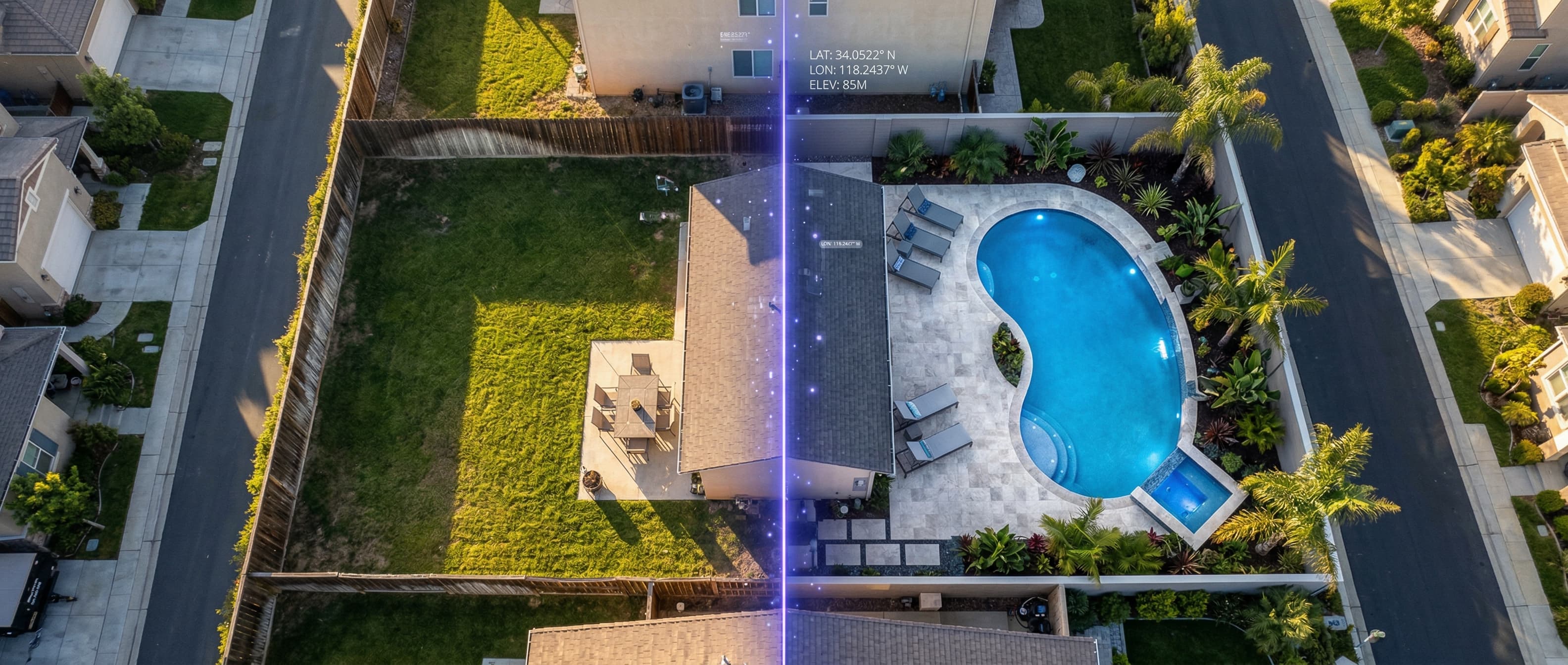
A workflow recently went viral on X: an agentic AI bot scans satellite imagery for mid-market homes without pools, filters by lot size and recent ownership change, looks up the owner in public records, renders a luxury pool into the actual backyard, calculates the home value lift, and mails the homeowner a personalized before/after postcard with a QR code — all on autopilot.
It sounds like a stunt. It isn't. A real comparable system — Scaped.ai — sent 578 postcards in Akron, Ohio, booked 48 appointments, closed 21 contracts, and generated $47,000 in revenue from $722 in mailers. That's a 65x ROI and a 8.3% response rate, against a direct mail industry baseline of 0.5–2%.
This post breaks down (1) what's actually happening under the hood, (2) the real numbers from comparable systems, (3) why frameworks like OpenClaw make this buildable by a single operator, and (4) how to translate the same playbook into other industries — from solar to dental to B2B SaaS.
If you sell anything with a high average order value and a visible "before state," you should be paying attention.
What the viral pool bot actually does
The full pipeline, end-to-end, looks like this:
- Scan satellite imagery of a target ZIP code for single-family homes with empty backyards.
- Filter the property list by lot size, sun exposure, home value band ($500K–$1.2M), and signals like recent ownership change (movers spend on home improvement at 3–4x the rate of long-term residents).
- Pull the homeowner's name and mailing address from public county records — not bought leads, not shared inquiries.
- Render a luxury pool dropped into their actual yard using a vision-aware image model (Nano Banana / Gemini 3 Pro Image, or a similar inpainting model).
- Calculate a personalized economic case — local build cost, expected home-value lift, and payback timeline for that specific ZIP.
- Generate a short cinematic video of the rendered backyard with the new pool (this is the optional "wow" layer).
- Print and mail a personalized postcard with the before/after, the homeowner's name, the financial summary, and a QR code.
- Retarget the same household digitally once the QR is scanned or the postcard hits.
Every step from sourcing to outreach is handled by an agent. The human operator's job becomes (a) defining the criteria, (b) approving the rendered postcards before they ship, and (c) answering the phone when leads call back.
The reason this works is that none of the individual pieces are exotic anymore. The shift is that they finally compose into one workflow that a single founder can run.
The real numbers: what hyper-personalized direct mail actually returns
The "OpenClaw pool bot" version of this hasn't published audited results yet, but a near-identical system in the landscaping vertical has — and the numbers are public.
The Scaped.ai Akron case study
A hardscaping contractor in Akron, Ohio used Scaped.ai — which scans Google Street View, uses AI to filter for properties needing landscaping work, generates a "dream yard" before/after, and ships personalized postcards — to run a single neighborhood-targeted campaign.
The reported results:
- 578 postcards mailed to a single high-potential neighborhood (Merriman Hills)
- 8.3% response rate (vs 0.5–2% generic direct mail baseline)
- 48 appointments booked
- 21 contracts closed
- ~$722 total campaign cost (at roughly $1.25 per mailer on the Scale plan)
- $47,000 in upfront revenue
- 65x ROI before counting recurring maintenance contracts
- ~$15 per appointment, ~$34 per closed deal
For comparison, a single Google Ads landscaping lead in Ohio costs $50–$100+, and Angi-style platforms force you to share each lead with 3–8 competing contractors. Personalized AI postcards demolished both on cost-efficiency.
Scaped.ai reports that contractors using the platform see an average 4.2% response rate — roughly 3–4x the direct mail industry average. That tracks with what we'd expect from the broader hyper-personalization research.
Why personalized direct mail outperforms
The Data & Marketing Association puts standard direct mail response rates at 2.7–4.4% (vs 0.12% for email, 0.08% for social media), with an average conversion rate of 14% (vs 1.9% for email).
Layering on personalization compounds those numbers:
- Adding just the recipient's name to a piece can lift response rates by ~135%.
- 52% of consumers say they're more likely to engage with personalized direct mail.
- Personalized email campaigns alone deliver 6x more transactions than generic versions; the same effect amplifies in physical media because the personalization is harder to fake.
- Repetition matters: less than 2% of sales come from the first mailing — the bulk closes between the 5th and 12th touch. (Translation: a one-shot test will undersell what an automated, multi-touch system actually returns.)
The pool/landscaping postcard takes personalization to the limit by showing the recipient their own house. It's the difference between "Dear homeowner" and "Here is what your house at 47 Maple Lane looks like with the pool you've probably already imagined."
That asymmetry is why this category of campaign converts at 4–8x baseline.
What's actually in the technical stack
The viral framing makes it sound like a single magic tool. It isn't. It's a stack of mature components glued together by an agent runtime. Here's what each layer is doing in 2026:
1. Property sourcing layer
- Satellite/aerial imagery: Google Maps Static API, Mapbox, Nearmap, or Bing Maps Aerial. Increasingly, dedicated providers like Xoople (which just raised $130M Series B for AI-ready Earth observation data) are productizing this for enterprise AI workflows.
- Property data and ownership records: county assessor APIs, ATTOM, Estated, Regrid, PropMix. These provide owner name, mailing address, lot size, year built, last sale date, and assessed value.
- AI vision filtering: tools like DealMachine's AI Vision Builder already score properties by analyzing satellite + street view imagery at ~$0.02 per scan. The same approach detects empty backyards, distressed roofs, or unkempt lawns at scale.
2. Computer vision and rendering layer
This is the layer that didn't exist 18 months ago and is the actual unlock.
- Nano Banana / Gemini 3 Pro Image (Google) is the workhorse for this category right now. It maintains scene fidelity, edits real photos without warping the rest of the image, supports up to 14 reference images per workflow, and can render legible text directly into images. Critically, it understands real-world logic — a pool placed in a yard sits where a pool would actually sit.
- Stable Diffusion + ControlNet stacks are the open-source alternative for teams who need to run inference cheaply and locally.
- Veo, Runway, Kling, or Sora for the optional cinematic video layer.
The result is an image where the homeowner sees their actual roofline, their actual fence, their actual trees — with a luxury pool slotted in believably. That's emotionally different from a stock photo, and the conversion data backs that up.
3. Personalization and economic modeling layer
A standard LLM call (Claude, GPT, Gemini) handles:
- "What does a 14x28 fiberglass pool cost to install in [ZIP]?"
- "What's the expected home value lift for a pool in this market?"
- "What's the payback period if the homeowner sells in 5 years?"
This layer gets fed into the postcard copy as a personalized economic argument: "Pool installations in 60614 typically add $42K–$58K in resale value within 24 months."
4. Print and fulfillment layer
- Lob, PostGrid, or Postalytics APIs handle on-demand postcard printing and USPS/national-carrier delivery.
- Scaped.ai's pricing reference point — ~$1.25–$2.75 per fully delivered piece including printing, postage, and AI generation — is the rough unit economic to plan against.
5. Retargeting layer
A unique QR code per postcard lets you pixel the homeowner the moment they scan, then run a Meta/Google/programmatic remarketing sequence. The physical postcard becomes the cookie.
6. The orchestration layer (this is where OpenClaw matters)
The reason this is worth writing about now — and not three years ago — is that gluing all six layers together used to require an engineering team. It doesn't anymore.
OpenClaw is an open-source agentic framework built by Peter Steinberger that's crossed 300K+ GitHub stars. It runs locally, connects to messaging surfaces (WhatsApp, Telegram, Slack, Discord, iMessage and 20+ others), and exposes a "skills" system where each capability is just a folder with a SKILL.md file. You write skills in plain Markdown or TypeScript. The agent can write its own skills based on a YouTube video or your notes.
In practical terms, that means a single operator can stand up the pool bot workflow as a set of OpenClaw skills:
property_scanner— calls the imagery + records APIsvision_filter— runs the empty-yard detectionpool_renderer— calls Nano Banana with the rendered prompteconomic_model— calls the LLM for the personalized payback mathpostcard_designer— composes the final assetmailer— calls the Lob/PostGrid APIcrm_sync— pushes the lead into the operator's pipeline (n8n, Airtable, HubSpot, whatever)
A heartbeat skill can run the whole pipeline on a schedule — say, 200 new properties scanned and 50 postcards approved per week — while the operator gets a Telegram message asking for approval before anything ships. That last bit matters: the human-in-the-loop gate is what keeps the system from sending something embarrassing to a real customer, and it's also a hard requirement under EU consumer protection rules.
The same architecture works in n8n, LangGraph, Inngest, or any agent runtime. OpenClaw is just the most accessible one for non-engineering operators right now.
Why this is happening now (and why it's a structural shift, not a fad)
Three things changed in the last 18 months that make this category of marketing real:
- Image models stopped hallucinating. Pre-2024 image generators couldn't preserve a real photograph while editing one element. Nano Banana, Gemini 3 Pro Image, and similar models can. That single capability is the unlock.
- Agentic frameworks got cheap and accessible. OpenClaw, Claude Code, n8n, and LangGraph let a single founder run workflows that previously required a 5-person ops team.
- Data brokers exposed APIs. Property records, satellite imagery, and print-on-demand mail are all just HTTPS endpoints now.
When all three curves cross, the cost of running a hyper-personalized marketing workflow drops by ~95%, and the conversion advantage stays. That's the definition of a structural advantage rather than a hack.
How to apply this outside the pool industry
The pool example is photogenic, but the playbook is not pool-specific. The pattern is:
High-AOV product + visible "before state" + addressable target list + a believable rendered "after"
Run that pattern across other verticals and the same workflow falls out:
| Industry | Before state | Rendered after | Targeting signal |
|---|---|---|---|
| Solar installers | Aerial photo of a south-facing roof | Same roof with panels rendered, ROI calculation | Homes in high-irradiance ZIPs without panels |
| Roofers | Drone or satellite of an aged roof | New roof rendered in customer's preferred material | Roof age via vision model + recent storm damage |
| Window replacement | Street view of single-pane facade | Modernized facade with new windows | Pre-1990 builds in mid-to-high income tracts |
| Landscaping | Bare front yard | Designed yard with drought-tolerant planting | Already proven by Scaped.ai and PostYards |
| Driveway / hardscape | Cracked asphalt drive | Stamped concrete or paver render | Visible deterioration via vision model |
| EV charger installs | Street view of garage | Wallbox installed beside the driveway | Recent EV registration + property type |
| Dental (clear aligners) | Front-facing selfie | Predicted post-treatment smile | Instagram lookalike audience + age band |
| Interior design | Photo of a dated living room | Three style variants of the same room | Realtor data on recent home purchases |
| B2B SaaS | Screenshot of the prospect's actual website | Same website with the SaaS product embedded | Funding signals, hiring signals, tech stack changes |
The B2B row is the one most marketers miss. Imagine a cold email to a SaaS founder where the hero image is their actual landing page, but rebuilt in 90 seconds by an agent to demonstrate exactly the conversion fix you'd pitch them. The reply rate on that message is not going to be 1%.
The risks and the limits
This isn't a magic button. There are five places where this category of campaign breaks:
1. Legal and privacy. In the EU, GDPR makes the "scan public records, render house, mail homeowner" workflow harder than in the US. You need a lawful basis for processing personal data, and "I scraped the county registry" is not always sufficient. In the US, CAN-SPAM doesn't apply to physical mail, but state laws vary. Don't run this in the EU without competent legal review. A compliant version usually means targeting businesses (B2B), or working with publicly-listed commercial properties, or operating in jurisdictions where the data is genuinely public-record.
2. The uncanny valley risk. A pool render that looks fake makes you look like a scam. A pool render that looks real makes the recipient call you. The model quality is the difference, and human approval before mailing is non-negotiable.
3. Targeting bad properties. Mailing a pool render to a household that just lost a job, or a home in a flood plain, is a brand-damaging mistake. The filter layer matters more than the render layer.
4. The follow-up gap. 80%+ of direct mail sales come from the 5th–12th touch. A single mailer is a test, not a campaign. The retargeting and email follow-up layers are not optional.
5. Saturation. The 4–8% response rate works because most homeowners have never seen something like this. When every pool builder in town is doing it, response rates regress toward the mean. The window for outsized returns on this specific tactic is probably 18–36 months. Move now or move late.
What this means for marketers who don't sell pools
If you take three things from this case study, take these:
First, the unit of marketing is shrinking from "the segment" to "the individual." The question is no longer "what's the best message for homeowners 35–55 in DACH?" It's "what's the best message for this household, rendered against their property, priced for their ZIP, mailed in their language?" The economics of generating that one-to-one asset have collapsed, and the conversion advantage hasn't.
Second, the moat is in the orchestration, not the model. Anyone can call Nano Banana. The defensibility is in the workflow that ties imagery, public records, vision filtering, rendering, fulfillment, and CRM together into a system that runs without you. Frameworks like OpenClaw exist specifically to make that orchestration cheap for solo operators and small teams.
Third, the highest-leverage move for most marketers in 2026 is to find the narrowest possible vertical where this pattern applies and run it before anyone else does. Not "we use AI in marketing." Not even "we do personalized direct mail." Specifically: "we find homeowners in [city] who [signal], render [asset] into [their property], and ship them a [specific deliverable] for less than the cost of one Google Ads click."
That sentence, with the variables filled in, is a business.
If you're trying to figure out which workflow to run first in your own business, that's the conversation we have at areza.digital. The pool bot is one example. The pattern generalizes. The window is open right now. Book a 30-minute discovery call →
FAQ
Is the OpenClaw pool bot a real product I can buy? The viral framing is a workflow concept, not a single SaaS. The closest commercial equivalents are Scaped.ai and PostYards in the landscaping vertical. The pool-builder version is currently being run by individual operators who stitch the components together themselves, often using OpenClaw, n8n, or Claude Code as the orchestration layer.
What's OpenClaw and why does it matter for marketing? OpenClaw is a free, open-source personal AI agent framework created by Peter Steinberger. It runs locally on your machine, connects to messaging apps (WhatsApp, Telegram, Slack, Discord, iMessage, 20+ others), and lets you define agent capabilities as simple Markdown "skills." It matters for marketing because it lets a single operator orchestrate end-to-end workflows — sourcing, rendering, fulfillment, follow-up — that previously required an engineering team.
What conversion rate should I realistically expect from AI-personalized direct mail? Based on published Scaped.ai data, 4–8% response rates are achievable with property-level personalization, versus 0.5–2% for generic direct mail. The Akron contractor case study reported 8.3% response and a 65x ROI on a $722 campaign. Treat 4% as a realistic baseline and 8%+ as a stretch goal that requires excellent targeting.
How much does it cost per piece? Roughly $1.25–$2.75 per delivered postcard, fully loaded (AI generation + printing + postage + USPS delivery), based on current Scaped.ai pricing. DIY workflows using Lob or PostGrid as the print fulfillment layer can land in a similar range at sufficient volume.
Which AI image model should I use for personalized property renders? Nano Banana / Gemini 3 Pro Image is the current best-in-class for editing real photographs without warping the rest of the scene. Open-source alternatives based on Stable Diffusion + ControlNet work for teams that need cheaper local inference.
Is this legal in the EU? It's complicated. GDPR requires a lawful basis for processing personal data, and direct marketing using publicly-available records is a contested area. Don't run a consumer version of this in the EU without a competent privacy lawyer. B2B variants targeting commercial properties are generally lower-risk.
What industries does this work in besides pools and landscaping? Any industry with a high average order value, a visible "before" state, an addressable target list, and a believable rendered "after." That includes solar, roofing, window replacement, hardscape, EV chargers, dental aligners, interior design, and B2B SaaS landing-page redesigns.
Do I need to be technical to build this? You need to be technical enough to wire APIs together, or to operate an agent framework like OpenClaw, n8n, or Claude Code. You do not need to be an ML engineer. The image generation, property data, and print fulfillment are all behind HTTPS APIs in 2026. The skill is in orchestration, not model training.
Written by Nikita Janochkin, founder of areza.digital. Sources: Scaped.ai Akron case study, Data & Marketing Association Response Rate Report 2023, Lob 2025 State of Direct Mail, Google DeepMind Nano Banana 2 launch documentation, OpenClaw documentation, DealMachine AI Vision Builder, TechCrunch coverage of Xoople's $130M Series B. Last updated April 10, 2026.
Stop losing leads to a slow website
Book a free friction audit and see exactly where your website is leaking money.