SaaS to GaaS: What Generate-as-a-Service Means for Your Pricing, Your Software, and Your Business in 2026
April 18, 2026
At NVIDIA GTC 2026, Jensen Huang made one of the clearest predictions of the agent era: every SaaS company will become a GaaS company. Here's what that actually means for how you buy software, how you charge your own customers, and how you compete over the next 18 months — without the hype.
The short version (TL;DR)
- GaaS (Generate-as-a-Service) is the emerging successor to SaaS. Instead of paying for seats to use software, buyers pay for outcomes that AI agents produce on their behalf.
- Jensen Huang anchored the term at NVIDIA GTC 2026 on March 16, 2026, calling the shift inevitable for every software company.
- Pricing is shifting from access to outcomes. Intercom Fin charges $0.99 per resolved customer conversation. Sierra AI passed $150M ARR in early 2026 on an outcome-based model, charging only when its agents resolve an issue autonomously.
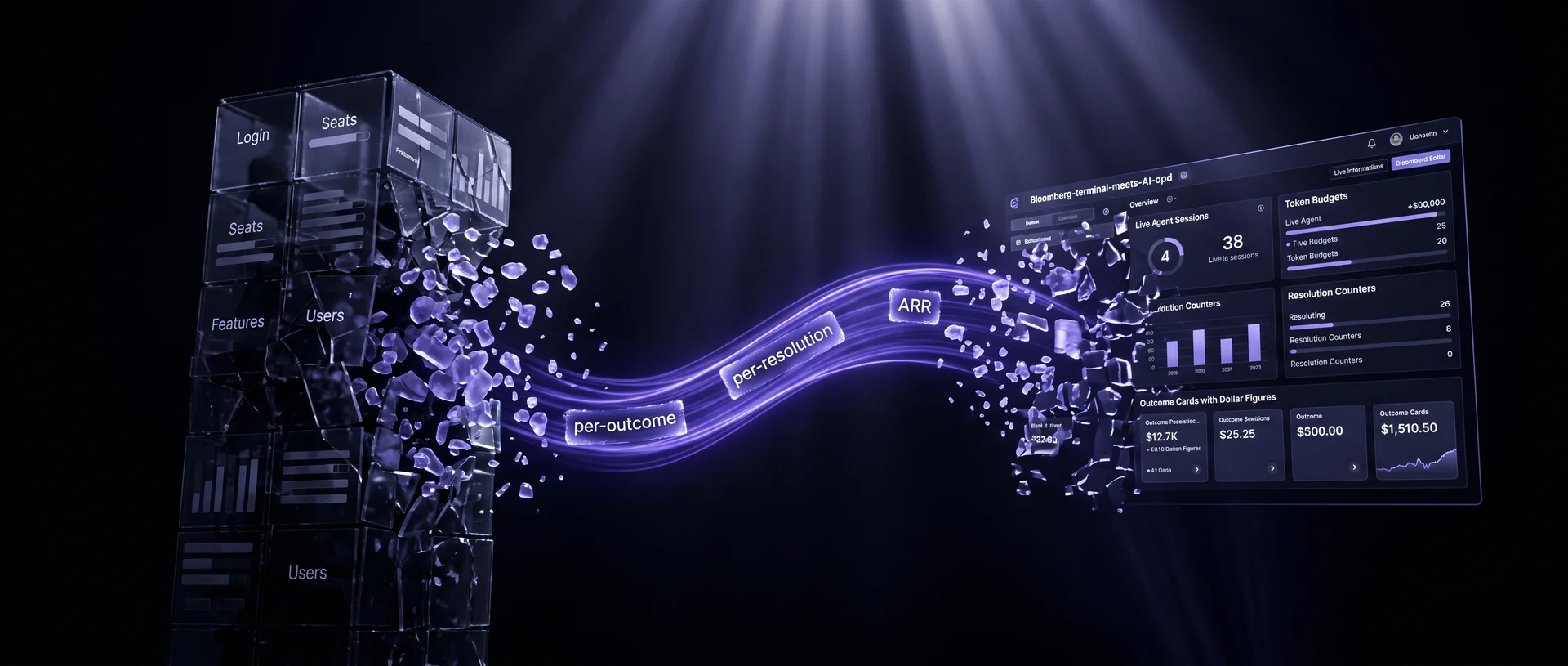
- Software itself is changing shape. The "login and click around" interface is being replaced by a three-layer pattern: instruction, observability, and outcome review.
- For business owners, this affects three things at once — the tools you buy, how you price your own services, and where your competitive moats actually live.
- Vertical depth is the moat. Generic agents are commodities. Agents that know your industry, your systems, and your real customers are defensible.
What is GaaS (Generate-as-a-Service)?
GaaS (Generate-as-a-Service) is a software business model in which customers pay for results produced by AI agents rather than for seats, logins, or time inside a tool. Where SaaS sold access to features a human operates, GaaS sells the completed work itself — a resolved ticket, a qualified lead, a published article, a closed invoice.
The term "Generate-as-a-Service" was popularized by Jensen Huang at NVIDIA GTC 2026, though the underlying shift had been building in the market since late 2024, with companies like Sierra AI, Intercom Fin, and Salesforce Agentforce experimenting with outcome-based pricing well before the acronym existed.
Some analysts also use "AaaS" (Agent-as-a-Service or Agentic-as-a-Service) interchangeably. The acronym will settle. The underlying business model already has.
What did Jensen Huang actually say at GTC 2026?
On March 16, 2026, on stage at the SAP Center in San Jose, Huang told an audience of 30,000-plus that every software company in the world would have to reinvent itself around AI agents. His framing — captured in multiple outlets covering the keynote — was that "every SaaS company will become a GaaS company, no question about it."
Two points from the keynote matter for business owners specifically:
1. Software will stop being sold as tools and start being sold as outcomes. Huang described future software companies as "token manufacturers" — producing work on behalf of customers, not selling them interfaces to do that work themselves.
2. Every company needs an agent strategy. The line most often quoted from the keynote — that every enterprise company and every software company needs an agentic strategy — is directed at buyers as much as builders. The transition affects anyone running a business that uses software, not just anyone building it.
Huang's prediction is unusually specific for a keynote. He did not say SaaS "will evolve" or that AI "will transform" software. He said one model replaces the other.
SaaS vs GaaS: the shift in one table
| SaaS (2000–2025) | GaaS (2026–) | |
|---|---|---|
| Unit of value | Access to a tool | A completed outcome |
| Pricing model | Per seat / per month | Per outcome / per action / hybrid |
| Primary user | A human inside the product | An agent acting on behalf of a human |
| Main interface | Navigation, forms, tables | Instruction + observability + review |
| Buyer's question | "How many people need a login?" | "How much work do I need done?" |
| Vendor's metric | Seats, DAU, feature adoption | Resolutions, actions, outcomes delivered |
| Moat | Integrations, switching cost, UI | Vertical depth, real-world proof, data access |
The important thing to notice is that every row changes together. Pricing, UI, and go-to-market strategy are not independent choices — they all fall out of one decision: is a human driving, or is an agent?
Why GaaS changes pricing: from access to outcomes
The four pricing models emerging in 2026
The market is openly experimenting with four distinct pricing shapes right now. Understanding them is not an academic exercise — it is how business owners will decide which tools to buy and how to charge their own customers.
1. Per-outcome (or per-resolution). The purest expression of GaaS. The vendor is paid only when the agent successfully completes a defined unit of work. Intercom's Fin AI Agent is the reference case — pricing is a flat $0.99 per resolved conversation, and no charge is applied if Fin hands off to a human without resolving. Intercom reports an average resolution rate of 67% across 40 million-plus conversations.
2. Per-action (credits). The agent consumes credits for each discrete action it takes — updating a record, summarizing a case, sending a message. This pattern dominates tools where "outcome" is harder to define crisply. Salesforce, HubSpot, Figma, Cursor, and Lovable all run credit-based models in 2026.
3. Per-token (consumption). Straight compute billing, passed through from the underlying LLM. Rare as a customer-facing model because tokens are opaque to non-technical buyers — it mostly appears in developer tools.
4. Hybrid (base fee + variable). A platform fee plus outcome-based overage. This is almost certainly where the market will settle for most categories, because pure outcome pricing creates revenue unpredictability for the vendor and budget volatility for the buyer.
Salesforce's own journey through the last 18 months is a useful preview: they shipped a $2-per-conversation model, then introduced Flex Credits priced by the action, then rolled out a "digital labor" license priced per user per month — all three now running in parallel while the market decides.
The proof: two companies already making outcome pricing work at scale
Sierra AI, founded by former Salesforce co-CEO Bret Taylor, reached $100M ARR in 21 months and crossed $150M ARR by January 2026 — one of the fastest revenue ramps in enterprise software history. Taylor has been explicit in interviews and podcasts that outcome-based pricing is not a tactical choice but a structural bet: Sierra only gets paid when its agents resolve an issue autonomously. If the agent escalates to a human, the customer pays nothing.
Intercom Fin is the scaled counterpart. With over 40 million conversations processed at $0.99 per resolution, Fin is a proof point that outcome pricing works not just at enterprise scale but across SMB and mid-market too. Intercom even guarantees a 50% automation rate — if Fin resolves fewer than half the conversations it handles, the customer gets credited back.
The pattern is identical in both cases: the vendor's incentive is fully aligned with the customer's. The vendor earns when work gets done. Not before, not if not.
What this means for your pricing — as a buyer and as a seller
As a buyer, you should expect — and push for — outcome-based or hybrid pricing on any AI-powered tool you evaluate in 2026. Flat per-seat pricing for an AI product is an early warning sign that the vendor hasn't thought about alignment.
As a seller of services, this is where most business owners freeze. The instinct is to keep selling retainers or hourly packages because those are what you know. But the market is rapidly re-anchoring on outcomes. If your competitor starts charging per-qualified-lead, per-published-article, per-resolved-ticket, or per-closed-deal, your flat retainer suddenly looks like a bet the customer can't measure. The work you sell doesn't have to be done by agents for your pricing to be outcome-based. But increasingly, your buyers will expect the language of outcomes, not the language of access.
Why GaaS changes software: from logins to dashboards
Most analyses of the AI shift stop at pricing. That is a mistake. The deeper change is what the software itself looks like when agents, not humans, are the primary users of the tool.
Traditional SaaS UI is navigation plus forms plus tables. Click here, fill this in, run a report, repeat. The human is the work engine.
GaaS UI has three new layers, and none of them look like the SaaS you grew up with.
Layer 1: The instruction surface
This is where a human tells the agent what outcome they want. It's often just a chat box. Sometimes a structured brief. Sometimes a calendar trigger or a form. The point is that the user specifies a goal, not a sequence of clicks.
"Qualify these 200 leads by Friday using criteria X" is an instruction. "Click New Lead, fill in these five fields, repeat 200 times" is a workflow. GaaS replaces the second with the first.
Layer 2: The observability surface
This is the new primary screen of a GaaS product. Think of it as an air traffic control dashboard for agents.
You watch sessions in real time — which agent is running, what task, how long it's taken, how much it has cost in tokens, what tools it has called, what succeeded, what escalated to a human. Parent agents spawn sub-agents; the hierarchy is visible. Cost cards show today's spend, all-time spend, and projected monthly burn. Active sessions have live status.
If you've never seen this kind of interface, the closest aesthetic reference is a Bloomberg terminal. Information-dense. Read-first, click-second. Because once agents do the work, your job shifts from clicking buttons to monitoring and auditing a swarm of workers.
Layer 3: The outcome and review surface
This is the queue of completed work waiting for human approval, the exceptions that need human judgment, and the KPIs tied directly to what the customer is being billed for.
For Intercom Fin, that means a dashboard of resolution rate, customer satisfaction per resolution, and per-conversation cost. For a GaaS SEO tool, it would mean a queue of draft articles awaiting approval, ranking movement per published piece, and per-article cost against organic sessions delivered.
The review layer is where humans earn their keep in a GaaS world. Not by doing the work, but by deciding which work ships and which gets kicked back.
What the shift to GaaS means for business owners specifically
Stripping away the acronyms, here are the five things that change for any business owner running a company in 2026 and 2027.
1. How you buy software
Your evaluation criteria flip. In the SaaS era, you asked how many seats you needed and how hard the tool was to learn. In the GaaS era, you ask how many outcomes the tool can produce and what the per-outcome cost is. A product without a crisp answer to "what exactly am I paying for, and what's the unit economics?" is a product that hasn't figured out its own model.
2. How you price your own services
Flat retainers and hourly billing will not disappear overnight, but they will increasingly look conservative next to outcome-aligned competitors. If you run a marketing agency, a development shop, a consulting business, or a services company of any kind, map your deliverables to countable outcomes and start testing outcome-based or hybrid pricing on at least one client. The goal is not to immediately restructure your business — it is to build the muscle before the market forces the issue.
3. How you staff and structure your team
Jensen's "every engineer carries a token budget alongside their salary" is the quote most people zeroed in on, and rightly so. Knowledge work teams will increasingly be measured not by headcount or hours but by the volume of outcomes produced — with agents doing a growing share of the execution. This changes hiring priorities (senior operators who can direct agents are worth more than junior executors who can be replaced by them), org charts (small pods with agent leverage can outperform large teams without), and training (prompt design, agent oversight, and outcome review become core skills).
4. Where your competitive moats actually live
The most important insight — and the one Bain and other analysts have been careful to flag — is that highly verticalized applications with deep domain expertise, real customer data, and hard-to-replicate integrations are the ones insulated from disruption. Generic AI tools are already commoditizing. An "AI content generator" is an easily replicated product. An "SEO agent that understands the March 2026 Google core update, your CMS, your industry, and your brand voice, and ships to production with measurable ranking gains" is not. Vertical depth is the moat. Real customer proof is the moat. Access to proprietary data is the moat. Generic capability is not.
5. The 18-month playbook
If you do nothing else after reading this, do three things over the next 18 months:
- Audit your software stack against outcome-based alternatives in each category. You do not need to switch — you need to know what the market is offering.
- Pilot one outcome-priced engagement with a customer who trusts you. Whether you sell services, products, or consulting, run one deal on outcome-aligned pricing to see how it reshapes the work.
- Pick one internal process and give it to an agent. Not as a toy. As a production workload, with measurable outcomes and a review queue. The operational learning from running one agent at scale is worth more than a year of reading about GaaS.
The moat most analyses miss: vertical depth and real customer proof
A warning worth emphasizing, because it applies to almost every business owner reading this: the winners in the GaaS era will not be the companies with the most impressive AI demos. They will be the companies with the deepest real-world proof in a specific domain.
Take SEO and organic content as a concrete example. In 2026, the market is flooded with generic "AI content tools." Most are commodity wrappers on the same underlying models. They all produce similar outputs. None of them can credibly tell a story about surviving a Google core update with a real client, rebuilding topical authority, shipping to a specific CMS under production constraints, or aligning to a brand voice that matches a specific buyer persona.
The companies that do have that story will win the GaaS transition in their vertical. Not because their models are better, but because their domain knowledge, their real-world scars, and their customer evidence are harder to replicate than the underlying AI.
If your business has a moat, it is almost certainly not the AI. It is everything you've learned, built, and survived around your specific market.
Frequently asked questions about GaaS
What is GaaS in simple terms?
GaaS (Generate-as-a-Service) is a model where you pay for work AI agents complete — like tickets resolved or leads qualified — instead of paying a monthly fee for access to software. It is the successor business model to SaaS in the agent era.
What is the difference between SaaS and GaaS?
SaaS sells access to a tool that a human uses. GaaS sells outcomes produced by an AI agent. The shift affects pricing (seats become outcomes), interface (navigation becomes instruction + observability), and buyer mindset (how many users do I have becomes how much work do I need done).
Is outcome-based pricing the same as GaaS?
Outcome-based pricing is the most visible component of GaaS, but the two are not identical. GaaS is the broader shift — software built around agents rather than humans. Outcome pricing is how most GaaS products charge, but some use credits, consumption, or hybrid models. Every GaaS product has rethought pricing; not every outcome-priced product is fully GaaS.
Will SaaS companies disappear?
Most incumbent SaaS companies will not disappear — they will evolve into hybrid models, adding agent capabilities and outcome-aligned pricing alongside their existing seat-based plans. Salesforce, HubSpot, and Intercom are already running multiple pricing models in parallel. The SaaS label will persist; the underlying business model will transform.
How do I prepare my business for GaaS in 2026?
Three steps: audit your current software stack against outcome-based alternatives, pilot one outcome-priced engagement with a trusted customer, and give one real internal process to an agent as a production workload. The operational learning from running one agent at real scale is more valuable than any amount of theoretical preparation.
What is an AI agent, compared to a GaaS product?
An AI agent is a software entity that plans, takes actions, and uses tools to accomplish a goal with minimal human input. A GaaS product is a commercial offering built around one or more agents, with pricing, UI, and distribution designed for the agent era. Every GaaS product uses agents. Not every agent is packaged as a GaaS product.
Do I need MCP (Model Context Protocol) to sell a GaaS product?
No — but you probably should support it. MCP is an open protocol, originally developed by Anthropic and now adopted across major AI vendors, that lets agents call your product as a tool. Exposing your product as an MCP server is one of the cheapest ways to make it reachable from inside the agents your customers already use (like Claude Code, Cursor, or ChatGPT). It is not required for a standalone GaaS product, but it lowers the cost of distribution significantly.
Is GaaS just hype?
The underlying business model shift is not hype — Intercom Fin, Sierra AI, and Salesforce Agentforce are each generating real revenue on outcome-based pricing, and public companies are repricing around it in real time. The hype is the acronym. The market will not wait for everyone to agree whether to call it GaaS, AaaS, or something else. The mechanics are already in motion.
Where to go from here
If you read this and thought "this shift applies to my business, and I don't know where to start" — that is the right response, and it is not a comfortable one.
The first useful move is not a technology decision. It is a mapping exercise: which of your deliverables could be priced on outcomes, which of your processes could be given to an agent, and where in your stack are you already paying for seats when you should be paying for work?
That is the conversation we have with clients most often at areza.digital. We work with founders and business owners across the EU and DACH region to audit their software stack, redesign pricing models around outcomes, and ship agent workflows into production — starting with the SEO and organic content layer, where the shift is already fully visible.
If you want to map out what the GaaS transition looks like specifically for your business — what to buy, what to stop paying for, what to automate, and how to re-price your own services — book a 30-minute discovery call →. No pitch. A structured conversation about where the leverage actually is in your business, and whether we're the right team to help you capture it.
The software era you built your business in is ending. The one replacing it rewards operators who move early, with specificity, on a single vertical. We would rather help you be one of them.
Written by Nikita Janochkin, founder of areza.digital. Facts in this post — Jensen Huang's GTC 2026 keynote, Intercom Fin pricing, Sierra AI ARR milestones, Anthropic's plugin launch on January 30, 2026 — were verified against primary sources at the time of writing. Last updated April 18, 2026.
Stop losing leads to a slow website
Book a free friction audit and see exactly where your website is leaking money.