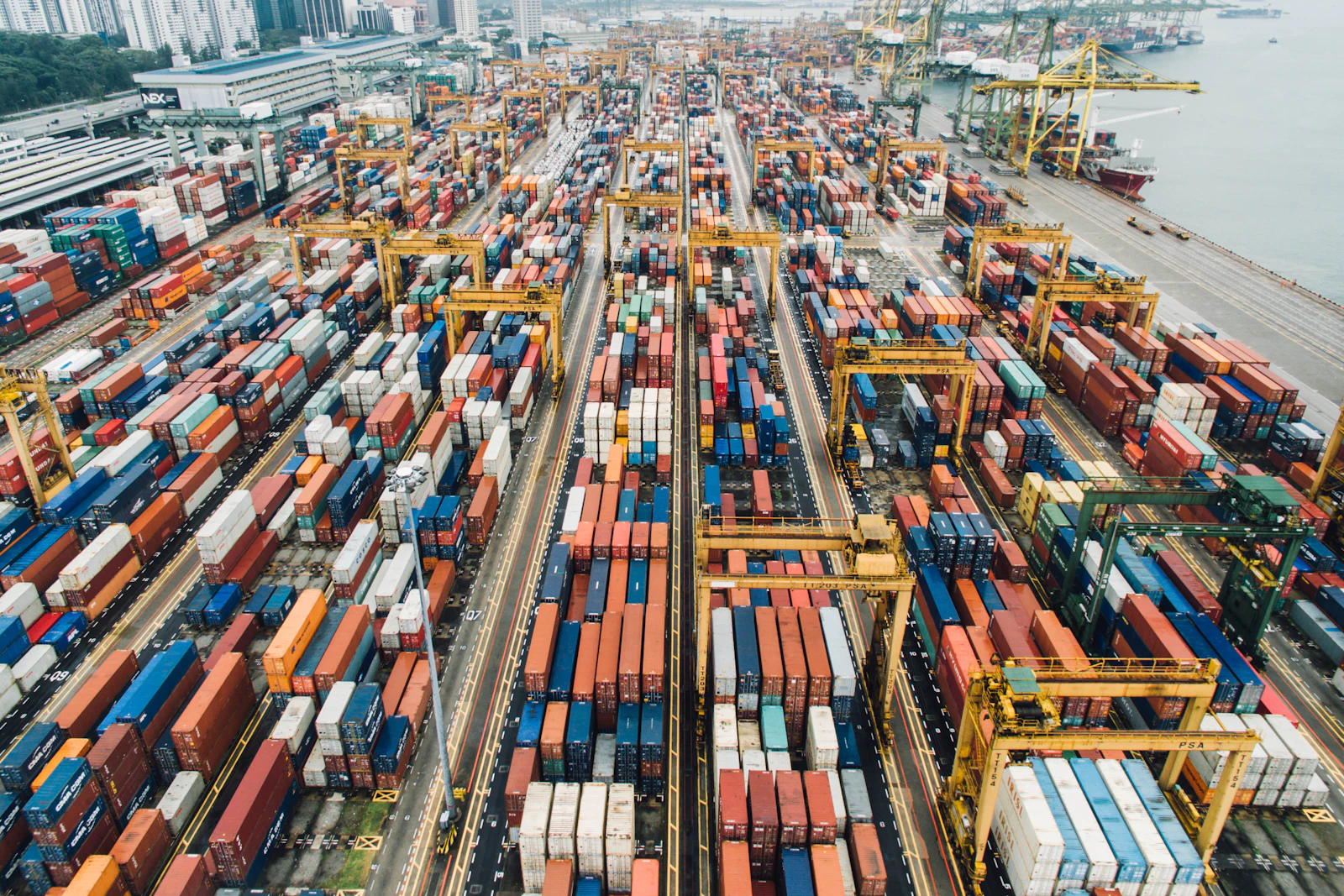
Germany · Logistics
Hamburg and the Rhine corridor move on lanes, commodities, and credentials.
Hamburg cleared 8.3M TEU in 2025 at +7.3% YoY — still EU #3 behind Rotterdam and Antwerp-Bruges, with the widest rail-hinterland reach in Europe. Duisburg sits inland at ~61.8M tonnes through the world's largest inland port, with the Duisburg Gateway Terminal opening in 2024 as the EU's largest inland container terminal. Beneath the named top-10 forwarders is a Mittelstand Spedition layer of ~50,000-60,000 SMBs, structurally invisible in AI search. Areza ships the Foundation, AI Search, Voice Agent, and customs-workflow stack that closes that gap — bilingual DE-EN, AEO-aware, CBAM-ready.
Book a Germany strategy call-
8.3M TEU · +7.3% YoY
Hamburg container throughput 2025 (EU #3)
Source: Port of Hamburg 2025 throughput release — PortEconomics top-15 EU container ports Q3 2025 (Q3 +8.4%, strongest of leading EU trio)
-
7.8M TEU · +0.9% YoY
Hamburg throughput 2024 (post-Red-Sea diversions)
Source: PortEconomics top-15 EU container ports 2024 — gap to Rotterdam + Antwerp-Bruges ~6M TEU and widening structurally
-
~61.8M t · >4M TEU equivalent
Duisburg inland port — world's largest
Source: Saloodo / Duisport profile 2024 — Duisburg Gateway Terminal opened 2024 as EU's largest inland container terminal; 60 China-Europe Railway Express trains/week
-
~50,000-60,000 firms
German logistics SMB count (BVL / DSLV)
Source: Bundesvereinigung Logistik (BVL) + Deutscher Speditions- und Logistikverband (DSLV) 2024 sector counts
-
70,000-120,000 open positions
BGL driver-shortage estimate
Source: Bundesverband Güterkraftverkehr Logistik und Entsorgung (BGL) 2024 — sector cost ~EUR 10B/year, 45% of active drivers already 55+
-
in force 1 Jan 2026
CBAM definitive phase — first reporting cycle
Source: European Commission Taxation + Customs Union — authorised declarant deadline 31 March 2026; first annual CBAM declaration due 30 September 2027 (covering 2026 imports)
AI landscape
The named tools shaping Logistics in Germany.
-
Sennder
Berlin digital freight forwarder. USD 160M Series E June 2024 at USD 1.3B valuation, led by Lakestar, Accel, HV Capital. Closed C.H. Robinson European surface-transport acquisition February 2025. The single most-funded German logistics-AI bet outside the named incumbents.
-
PTV Group (Karlsruhe)
Europe's market-leading route-planning software, founded 1979 as a KIT spin-out, now part of Umovity post the Bridgepoint carve-out from Porsche SE. Smartour + Map&Guide deployed inside Edeka, Rewe Logistik, and the bulk of large German fleet operators.
-
Transporeon (Ulm)
Modular TMS + transport-execution network across 27 countries, ~1,400 employees. Acquired by Trimble for ~USD 2B in April 2023. AI-powered Transport Planner rolled out across the enterprise base — BSH Hausgeräte and Schaeffler publicly named.
-
AEB SE (Stuttgart)
German customs-software market leader — ~7,000 enterprise customers, 13 offices in 8 countries, AEO-S certified since 2010. ATLAS export/import filings, sanctions screening, classification, broker integration, all in DE-hosted data centres. MIC Customs Solutions (Linz) competes for the mid-market; Descartes covers the global enterprise end.
-
Magazino (Munich, Jungheinrich-owned)
Perception-driven mobile robotics. SOTO bot deployed at MAN Nuremberg for intra-plant supply between warehouse and assembly line — the canonical German production-logistics AMR reference. Operates independently inside the Jungheinrich enterprise channel after the 2023 acquisition.
-
DHL × Robust.AI + HappyRobot
DHL Supply Chain partnership with Robust.AI on the 'Carter' collaborative robot for warehouse material handling, alongside 7,000+ Locus + other AMRs globally. DHL Group's November 2025 HappyRobot AI Agents rollout is the first named DE top-10 forwarder voice-agent deployment at scale.
-
project44 · FourKites · Shippeo
Real-time visibility tier. project44 and FourKites lead globally with DACH offices and heavy German shipper books; Shippeo is French-headquartered with significant Munich + Frankfurt presence. All three integrate against SAP TM and the German TMS stack.
-
Soloplan CarLo · AllRound TM · Mercator iSeries
German Mittelstand TMS bench. Soloplan CarLo is the canonical owner-operator forwarder TMS; AllRound TM and Mercator iSeries round out the German-native layer. Riege Software's Scope competes in air/ocean. SAP TM remains the enterprise default.
Cluster landscape
Hamburg, Bremen, the Rhine corridor, Frankfurt — what the freight map actually looks like.
Germany is the freight backbone of the EU. Wholesale + retail + transport + hospitality together produce ~16% of national gross value added (Destatis 2024), and logistics is the third-largest employer in the economy after retail and healthcare (BVL 2024 sector brief). The market splits cleanly along two anchor geographies — the Hamburg maritime cluster and the Rhine corridor running Duisburg → Cologne → Mannheim → Karlsruhe → Basel.
Hamburg is Europe's #3 container port behind Rotterdam and Antwerp-Bruges. In 2024 it handled 7.8M TEU at +0.9% growth, dragged by the German recession and Red Sea diversions; in 2025 throughput rebounded to 8.3M TEU at +7.3% YoY, with Q3 2025 the strongest of the leading EU trio at +8.4% (PortEconomics top-15 EU 2024 + Q3 2025; Port of Hamburg 2025 release).
The gap to Rotterdam and Antwerp is ~6M TEU and widening structurally — Hamburg's wedge is rail-hinterland reach (50%+ of throughput leaves on rail vs <15% at Rotterdam), not maritime scale.
Duisburg anchors the inland leg. ~61.8M tonnes annual throughput and >4M TEU equivalent, the world's largest inland port. The Duisburg Gateway Terminal that opened in 2024 is the largest inland container terminal in Europe, with ~60 China-Europe Railway Express trains arriving weekly from Shenzhen, Chongqing, and Wuhan (Saloodo + Railway.supply).
Cologne, Mannheim, and Karlsruhe carry chemicals, auto, and machinery throughput south. The Rhine corridor moves ~200M tonnes of inland-waterway cargo annually and is the EU's only sustained-low-water risk transport artery — the 2018 and 2022 low-water events each shaved ~0.4% off German GDP.
The forwarder layer above this infrastructure is named-group-dominated. DHL Group (Bonn HQ, USD 80B+ revenue), Kuehne+Nagel (Swiss-listed but German-heavy ops), DSV (now the world's largest forwarder by sea+air volume after the 2024 Schenker acquisition closed), Schenker (now CMA CGM-owned after the DSV sale completed), Hellmann, Dachser, Rhenus, and Imperial Logistics.
Beneath the top-10 sits the SMB tier — ~50,000-60,000 Mittelstand Spedition, warehouses, and last-mile operators (BVL + DSLV). The German 3PL market sits at USD 19.5B-44.9B depending on scope (Expert Market Research; Verified Market Research 2024), growing 3.3-4.8% CAGR.
Niche specialisations cluster geographically: pharma cold-chain around Frankfurt and the Rhine-Main hub (Boehringer + Sanofi DE + Merck Darmstadt anchor demand), auto-parts JIS on the Stuttgart corridor for Bosch/Mercedes/Porsche, food-temperature-controlled along the Rhine, maritime forwarding in Hamburg and Bremen, and rail-freight nationally via DB Schenker and Rail Cargo Group.
Operational reality
What a German Spedition SMB actually looks like.
20-500 FTE typical. Owner-operator at the top, three or four dispatchers in the Verkehrsleitstand, a warehouse manager, a Buchhaltung team, a small sales group. The customer book is ~70% B2B contract logistics — multi-year framework agreements with Mittelstand manufacturers, food producers, or chemical companies — and ~30% spot freight booked through Timocom, Trans.eu, or direct phone.
Margin pressure is the constant. Post-COVID spot rates collapsed across 2023-2024; AdBlue and diesel costs compressed gross margin; the post-2022 energy crisis still rolls through forwarder P&Ls. The dominant operational constraint sits underneath all of that: the driver shortage.
BGL estimates 70,000-120,000 unfilled positions today, with broader sector estimates running to 400,000 over the next decade as 45% of active drivers are already over 55 (trans.info; BGL spokesperson). Sector studies put the macro cost at ~EUR 10B annually.
Buying motion is slow and references-heavy. 3-9 months for SaaS, 9-18 months for anything touching TMS or customs filing. Decisions route through BVL and DSLV networks, IATA and IRU credentials carry real procurement weight, and being able to point to a peer customer on the same Verband shortens the cycle materially.
Customer-portal integration is the gating technical question — German shippers expect connectors into SAP TM, Mercator iSeries TMS, Soloplan CarLo, Microsoft Dynamics 365 logistics, or directly into OEM portals (Mercedes EDI, BMW eFAST, VW LIPS).
Language reality is bifurcated. German is non-negotiable for inland forwarders, regional Spedition, and most Mittelstand contract logistics. English is acceptable and often preferred for cross-border maritime forwarding out of Hamburg and Bremen, and for Berlin-based digital-native platforms. Sie vs. Du splits the same way — Hamburg port-side and Berlin freight-tech tolerate Du, the Rhine corridor and Bavaria default to Sie. We mirror the register the buyer signals; we never assume.
Areza service mapping
Where each service lands inside a German Spedition.
Foundation — bilingual DE-EN forwarder site engineered for AI-search extraction. Lane specialisations explicit (Hamburg-Antwerp shortsea, Rotterdam-Duisburg barge, DE-PL road, DE-IT alpine), commodity expertise explicit (pharma cold-chain, automotive JIS, project cargo, breakbulk, reefer, ro-ro), and customs credentials surfaced (AEO-F authorisation, ATLAS connection, IATA CASS membership).
The page structure is built so AI agents can extract (lane × commodity × credential) tuples cleanly — the unit of citation that currently has no native home in the German freight web.
AI Search — citation queries are sparse and winnable. 'Spedition [Stadt] [Verkehrsträger]', 'freight forwarder Hamburg [commodity]', 'Pharma Kühlkette Spedition Deutschland', 'Zollabwicklung [Hafen] [Warengruppe]', 'Gefahrgut-Spedition ADR Klasse [N]'.
The current SERP is dominated by DSLV/BVL directory listings, Wer-liefert-was and Kompass entries, and a thin layer of corporate group sites. Almost no SMB Spedition is structured for ChatGPT, Perplexity, or Gemini citation today. That is the wedge — and it is open.
Voice Agent — bilingual shipment-status inquiries are the canonical inbound. 'Wo ist meine Sendung?' + ETA + customs status accounts for the majority of dispatcher phone-volume, and phone remains the dominant carrier-customer-shipper channel in DE inland logistics.
The same agent handles intake for new business, AdBlue and Maut Q&A for drivers, and after-hours dispatch coverage. The DHL HappyRobot deployment (November 2025) is the public reference point at top-10 scale; the SMB equivalent is a configured Voice Agent under the forwarder's own number, voice, and disposition tree.
Workflow Ops — customs-document automation across CMR, EUR.1, ATA Carnet, T1/T2 transit, and Zollanmeldung filings via ATLAS. TMS integration into Soloplan CarLo, Riege Scope, AllRound TM, or SAP TM. OEM customer-portal workflow into Mercedes EDI, BMW eFAST, VW LIPS.
Newly load-bearing from January 2026: CBAM declarant workflow for steel, aluminium, cement, fertiliser, hydrogen, and electricity imports — forwarders are not the declarant of record but they sit on the documentary chain, and embedded-emissions data has to be passed through.
Knowledge Bot — trained on the forwarder's own lane book, customs procedures, IATA DGR + ADR + IMO IMDG + ISPM-15 references, and a customer-engineer FAQ. The operational wedge is dispatcher onboarding. The driver shortage is mirrored on the dispatch side — IHK Spediteurkaufmann/-frau apprenticeships run 18%+ short of target, and the institutional knowledge embedded in a 20-year dispatcher walks out the door at retirement. A Knowledge Bot keeps that knowledge addressable.
Growth Stack — B2B content + trade-show pipeline. transport logistic Munich is the canonical biennial industry show (next edition June 2027), Hamburg Maritime Conference, Intermodal Europe (Rotterdam-rotating), and the BVL Logistik-Kongress in Berlin every October. Account-based outbound runs into the named-shipper Mittelstand list filtered by Verband membership.
Regulatory + compliance
GüKG, ADR, AEO, UCC, GDPR, LkSG, CBAM — the regulatory stack AI tooling lives inside.
The German logistics regulatory stack is denser than tech buyers usually realise, and AI tooling lives inside it rather than above it. GüKG (Güterkraftverkehrsgesetz) governs federal road-haulage licensing; the Verkehrsleiter is personally liable. GGBefG + ADR (UN road) + IATA DGR (air) + IMO IMDG (sea) govern hazardous-goods carriage — classification is the single most-error-prone customs workstep and a prime AI workflow target.
AETR + the EU Mobility Package govern driver hours, cabotage, and posting-of-workers rules. AI tachograph-analysis tools live here. EU AEO (Authorised Economic Operator) is the credential ladder — F/S/C variants, with AEO-F the gold-standard for German forwarders and sub-1,000 holders nationally. UCC (Union Customs Code) governs AI customs-decision automation; ATLAS is the German national filing system, with AEB and MIC Customs Solutions as the dominant software layer above it.
GDPR + BDSG govern driver-monitoring, telematics, and customer data — Frankfurt data residency is procurement-baseline, BfDI plus 16 state DPAs are the enforcement reality. LkSG (Lieferkettensorgfaltspflichtengesetz) cascades human-rights and environmental reporting down to suppliers + 3PLs, and the forwarder sits inside the cascade whether or not they trip the firm-size threshold themselves.
EU AI Act runs a lighter regime for logistics than for finance or health — high-risk classification only triggers where AI controls safety components of vehicles or essential-services access.
CBAM (Carbon Border Adjustment Mechanism) is the newest live-load item. The definitive phase entered force 1 January 2026 (European Commission Taxation + Customs Union). Authorised declarant deadline is 31 March 2026; the first annual CBAM declaration is due 30 September 2027, covering 2026 imports of steel, aluminium, cement, fertiliser, hydrogen, and electricity.
Forwarders carrying any of those commodities through Hamburg, Bremen, or Rhine-corridor terminals sit on the documentary chain — embedded-emissions data has to flow through the freight booking, the customs filing, and the importer's reporting in a way that today's TMS layer was not built for.
Search + AI citation gap
Where the (lane × commodity) query goes invisible.
German freight-forwarding searches are fragmented across three overlapping directory layers — the BVL member directory, the DSLV Speditionsverband listings, and Wer-liefert-was / Kompass-style B2B indices.
A query like 'Spedition Hamburg Pharma' surfaces 6-10 directory pages, two corporate group sites, and almost zero structured SMB forwarder content. 'Zollabwicklung Lithium-Ionen-Akkus Hamburg' returns ADR-class-9 generic content plus ABBYY and AEB product pages, but no operator-side specialist.
That is the AI-citation gap. ChatGPT and Perplexity researching 'best pharma cold-chain forwarder Hamburg' or 'freight forwarder for ATEX-rated cargo from Antwerp to Duisburg' pull from directory listings and corporate boilerplate, because nothing else is structured for them.
The Areza wedge is direct — AI-search-friendly content per (lane × commodity) combination, with each page carrying the credentials, equipment list, lane-history detail, and customs-procedure references an AI extractor needs to cite. The same content stack also captures the long-tail organic Google traffic that is currently leaking to BVL/DSLV/Wer-liefert-was.
Case studies
Public patterns in Logistics that inform the Areza wedge.
-
DHL Supply Chain — Robust.AI 'Carter', Locus Origin, HappyRobot AI Agents
DHL Supply Chain runs 7,000+ mobile robots globally and doubled order-fulfilment productivity with Locus Origin. The 2024 Robust.AI partnership added the collaborative 'Carter' bot for warehouse material handling on top. In November 2025 DHL Group rolled out HappyRobot AI Agents for operational efficiency and customer communications — the first named German top-10 forwarder voice-agent deployment at scale. The reading for the Spedition SMB tier: the canonical top-of-market reference for voice + robotics is now public and configured against German operational reality, which collapses the buying-committee objection that 'this has not been done in our market'. Areza's Voice Agent + Workflow Ops bundle is structured on the same pattern, sized to a 20-500 FTE operator rather than a global supply-chain network.
-
Sennder — USD 160M Series E and the C.H. Robinson Europe acquisition
Berlin-founded digital freight forwarder Sennder raised a USD 160M Series E in June 2024 at a USD 1.3B valuation, led by Lakestar with Accel and HV Capital. In February 2025 it closed the acquisition of C.H. Robinson's European surface-transport operations — the digital-forwarder consolidation thesis funded into reality. For Mittelstand Spedition watching from outside the cap table, the operational signal is that the customer-side experience the named OEMs and large shippers expect — real-time visibility, AI-assisted procurement, single-click rebooking — is now table-stakes. The Foundation + AI Search wedge is precisely the layer that lets an SMB forwarder compete on lane expertise and credentials without having to rebuild Sennder's tech stack.
-
PTV Smartour and Transporeon — AI inside the named German vendors
PTV Group (Karlsruhe, KIT spin-out) ships Smartour AI route optimisation across most large German fleet operators, with Edeka and Rewe Logistik among the public references. Transporeon (Ulm) was acquired by Trimble for ~USD 2B in April 2023 and has since rolled out the AI-powered Transport Planner across its enterprise base — BSH Hausgeräte and Schaeffler publicly named. The implication for the SMB Spedition tier: the AI capability layer is already inside the TMS stack the forwarder runs, but the marketing surface (the site, the lane content, the AI-search citability) has not caught up. Areza ships the surface layer that lets the AI inside the TMS show up to the buyer.
-
Magazino SOTO at MAN Nuremberg
Munich-based Magazino — acquired by Jungheinrich in 2023 but operating independently inside the enterprise channel — deployed its SOTO autonomous small-load-carrier bot at MAN Nuremberg to automate intra-plant supply between warehouse and assembly line. The canonical German production-logistics AMR reference, now scaled inside Jungheinrich's distribution. The lesson for the contract-logistics 3PL: warehouse robotics is a real budget line for OEM and tier-1 customers, and forwarders that can speak fluently about the integration touch-points (yard, dock, put-away, line-side) win the contract-logistics conversation that pure trucking forwarders lose.
Let's build the foundation your business actually deserves.
Frequently asked
-
Is AEO-F certification worth the audit cost for a Mittelstand Spedition in 2026?
Yes, with one condition. AEO-F is the gold-standard German credential, with sub-1,000 holders nationally — the procurement signal is unambiguous. The audit cost is non-trivial (typically EUR 15-40K for a 20-200 FTE forwarder including internal time), and the renewal cycle is ongoing. The condition: AEO is only worth it if the operator can surface the credential cleanly in customer-facing content, supplier-onboarding documents, and customs-filing automation. We Foundation-publish the credential against the (lane × commodity) pages where it actually shifts the decision, and Workflow-Ops it into ATLAS filings via AEB or MIC so the procurement signal becomes a daily operational benefit, not a wall-poster.
-
What does a (lane × commodity) AI-search content strategy actually look like?
One page per material combination the forwarder genuinely runs. 'Hamburg-Antwerp shortsea reefer for citrus' is a page; 'Rotterdam-Duisburg barge for steel coil' is a page; 'DE-IT alpine road with ADR class 3 fuel' is a page. Each page carries lane history (transit times, frequency, peer references), commodity expertise (handling, temperature range, hazard class, packaging), credentials (AEO-F, IATA CASS, ADR fleet, ISO 9001/14001), and customs-procedure detail (T1/T2, EUR.1, ATA Carnet flow). A typical Spedition has 15-40 genuine (lane × commodity) combinations — that is the publishable surface. The AI engines reward exactly this structure, and the directory layer (BVL/DSLV/Wer-liefert-was) does not produce it.
-
How does CBAM affect a forwarder that is not the declarant of record?
The forwarder sits on the documentary chain even when it is not the declarant. From the January 2026 definitive phase, embedded-emissions data for steel, aluminium, cement, fertiliser, hydrogen, and electricity imports has to flow through the freight booking, the customs filing, and into the importer's CBAM declaration (first annual filing due 30 September 2027 covering 2026 imports). In practice this means the forwarder's TMS and customs stack has to capture commodity codes against the CBAM-covered HS list, attach embedded-emissions documentation from the shipper, and pass it through to the authorised declarant via ATLAS. Workflow Ops bolts the CBAM data-capture step into the existing customs workflow rather than building it as a parallel system.
-
What does customer-portal integration into Mercedes EDI, BMW eFAST, or VW LIPS actually cost?
The honest range: EUR 8-30K of initial integration work per OEM portal for a Spedition not already connected, plus ongoing maintenance whenever the OEM ships a schema change. Internal integration teams at top-10 forwarders absorb this; SMB Spedition typically defers, and loses the contract-logistics RFQs that require it. Areza's Workflow Ops covers the configuration layer — building the connector once against the operator's TMS (CarLo, Scope, AllRound TM, Mercator iSeries, or SAP TM) and maintaining it through OEM schema revisions — so a 50-FTE operator can credibly bid on Stuttgart auto-JIS work without staffing a permanent EDI engineer.
-
Can a Voice Agent meaningfully offset the driver shortage and dispatcher onboarding gap?
Not directly — a Voice Agent does not drive trucks. Indirectly, yes, in two measurable ways. First: shipment-status inbound 'Wo ist meine Sendung?' calls absorb 30-50% of dispatcher phone-volume in a typical Spedition, and a bilingual DE-EN Voice Agent handling status + ETA + customs-state queries against the TMS frees that dispatcher capacity for actual disposition work. Second: a Knowledge Bot trained on the forwarder's lane book + customs references + ADR/IATA DGR + ISPM-15 cuts the time a new dispatcher needs to ramp from cold to autonomous from ~6 months to ~6 weeks. Neither solves the BGL 70K-120K driver gap. Both materially soften the dispatcher-side capacity ceiling that the driver shortage is pushing the SMB Spedition into.
-
Why hire an external agency rather than build a digital-marketing lead in-house?
Both work — the honest split is timing and structural cost. A Spedition above ~250 FTE with steady RFQ flow into the top-10 named-shipper book justifies an in-house digital lead (~EUR 80-120K loaded), reporting to the Geschäftsführer. Below that scale, the math favours an external operator: the AI-search + Foundation + Workflow Ops capabilities are not full-time roles, and the cost of mis-hiring a generalist who does not know AEO, ATLAS, BiPRO, or the Mercedes-EDI quirks is higher than the cost of contracting it. We typically run as a fractional digital function — bilingual content, AI Search retainer, Voice Agent + Workflow Ops configuration — alongside the operator's own dispatch, customs, and sales teams.
Where to start
Services that fit Logistics in Germany.
- AI Search
The (lane × commodity) citation gap is wide and open — directories own the SERP but produce no citable depth. Cheapest legitimate growth channel for SMB Spedition in 2026.
- Workflow Ops
Customs automation across ATLAS + CMR/EUR.1/ATA Carnet/T1/T2, TMS integration into CarLo + Scope + SAP TM, OEM-portal connectors, and the new CBAM declarant data-capture layer.
- Voice Agent
Bilingual DE-EN shipment-status, intake, and after-hours dispatch coverage. Offsets dispatcher-side capacity pressure that the driver shortage is pushing operators into.
Further reading
Operator-perspective writing.
Reviewed by Nikita Janockin, Founder · Last updated 17 May 2026
Sources (6) →
- Port of Hamburg 2025 throughput release — PortEconomics top-15 EU container ports Q3 2025 (Q3 +8.4%, strongest of leading EU trio)
- PortEconomics top-15 EU container ports 2024 — gap to Rotterdam + Antwerp-Bruges ~6M TEU and widening structurally
- Saloodo / Duisport profile 2024 — Duisburg Gateway Terminal opened 2024 as EU's largest inland container terminal; 60 China-Europe Railway Express trains/week
- Bundesvereinigung Logistik (BVL) + Deutscher Speditions- und Logistikverband (DSLV) 2024 sector counts
- Bundesverband Güterkraftverkehr Logistik und Entsorgung (BGL) 2024 — sector cost ~EUR 10B/year, 45% of active drivers already 55+
- European Commission Taxation + Customs Union — authorised declarant deadline 31 March 2026; first annual CBAM declaration due 30 September 2027 (covering 2026 imports)