Digital marketing in Poland: a two-front search problem
Polish buyers search on Google and shop on Allegro. What that means for SEO, content, local search and AI answers, with sourced figures on the Polish market.
Areza Digital
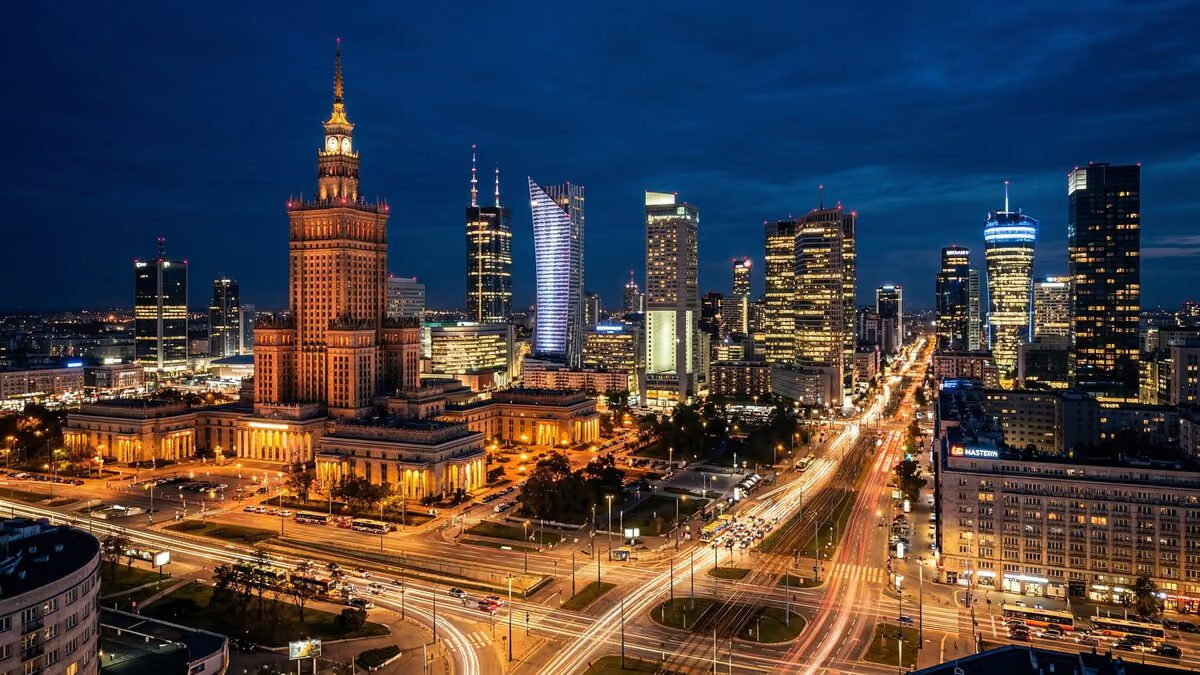
A common first mistake when entering Poland is to treat it as a smaller Germany: translate the site, run Google Ads, wait for enquiries.
Poland has two search fronts. Google handles general search. Allegro, the Polish marketplace, is where many Polish shoppers go to look for products. A consumer brand that ranks on Google but has no presence on Allegro is missing the place many Polish shoppers start. A B2B supplier has a different problem: Polish buyers research in Polish, and a translated English site rarely answers the questions they ask.
The short version
- Google is the general search engine in Poland, with about 89% of search traffic in August 2026; Bing has about 7% (StatCounter).
- Allegro had 15.3 million active buyers in Poland at the end of 2025, spending about PLN 4,300 each over the previous twelve months (Allegro Q4 2025 results).
- Polish digital advertising reached a record PLN 9.5 billion in 2024, up 19.8% (IAB Polska / PwC AdEx).
- Consumer brands need both Google and Allegro. B2B firms need Polish-language content written for Polish buyers, not a translation.
The Polish digital landscape
How many Poles are online
DataReportal counted 34.1 million internet users in Poland in October 2025, 89.8% of the population (DataReportal, Digital 2026: Poland). In Gemius’s 2025 e-commerce survey, 78% of internet users said they had bought something online (Gemius, E-commerce w Polsce 2025).
The audience is online and used to buying there. The work is in reaching it in the right place and the right language.
Search is Google, in Polish
Google’s share of Polish search traffic was 89.42% in August 2026, with Bing at 7.22% (StatCounter). StatCounter measures page views from search referrals, not people, but the direction is clear: for general search, Google SEO comes first.
Most of those searches are in Polish. English is widely spoken among Polish professionals, and Poland sits in the “high proficiency” band of the EF English Proficiency Index 2025. That index is based on people who chose to take EF’s test, so treat it as a signal, not a census. English content can help you reach international teams in Warsaw. It does not replace Polish pages for people researching in their own language.
Three things to plan for in Polish search:
- Inflection. Polish nouns have seven cases, so the same idea appears with different endings. “Agencja marketingowa” (nominative) becomes “agencji marketingowej” (genitive) or “agencję marketingową” (accusative); “Warszawa” becomes “w Warszawie” in the locative. Check which forms people actually type in your keyword tool instead of assuming the dictionary form.
- Branded search. Once buyers have seen your name in an ad, a marketplace or a recommendation, many will search for it directly. The page they land on needs to answer their questions in Polish.
- AI answers in search. Google has shown AI Overviews in Poland, in Polish and English, since March 2025 (Google). More on that below.
Allegro: the second search engine
Allegro is Poland’s largest marketplace. It had 15.3 million active buyers in Poland at the end of 2025, and its Polish operations handled PLN 66.4 billion of gross merchandise value that year (Allegro Q4 2025 results). Allegro counts an active buyer as a unique email address that made at least one purchase in the previous twelve months.
The brand recognition is even stronger. In Gemius’s 2025 survey, 86% of respondents named Allegro unprompted as an online shopping service, 71% named it first, and 78% said it was the platform they trusted most for online shopping (Gemius).
Allegro is also an advertising platform. Its Sponsored Offers product generated PLN 1.2 billion of revenue in 2025, according to the same results presentation. Sellers pay to appear in Allegro’s own search results, much as they would on Google.
For consumer products, that makes Allegro a search channel in its own right. Google and Allegro serve different moments: Google for research, comparisons and brand searches; Allegro when someone is ready to compare offers and buy. Treating them as competing channels misses the point. Most consumer brands need both.
Social platforms
Advertising reach figures from late 2025 give a sense of scale (DataReportal):
Swipe or scroll to compare.
| Platform | Advertising reach in Poland, late 2025 | Share of population used by DataReportal |
|---|---|---|
| 18.7 million users | 49.2% of the total population | |
| TikTok | 12.4 million users aged 18+ | 39.8% of adults |
| 9.2 million members | 24.2% of the total population |
Ad reach counts accounts the platforms say they can target, not unique active people. It is useful for comparing channels, not for sizing a campaign exactly. For B2B, LinkedIn is the obvious professional channel. For consumer brands, Facebook gives the broadest reach, and TikTok matters for younger audiences.
What works for B2B digital marketing in Poland
Content written for Polish buyers
Polish B2B buyers expect content that reflects Polish conditions: local regulation, tax and invoicing rules, the labour market, and the competitors they already know. A page translated from English, with British examples and German legal references, tells them the supplier has not done that work.
Write Polish content with native speakers who understand the sector, or at least have it edited by one. Machine translation is a reasonable first draft for internal use. It is not the page that should represent you to a Polish finance director.
Polish SEO
The technical principles are the same as anywhere else. The Polish-specific work is mostly about language and local signals:
Keyword research by form, not just by word. Collect the phrasings buyers use, including the inflected forms and the questions they ask (“ile kosztuje…”, “jak wybrać…”). Group them by intent, and write one useful page per intent rather than one page per grammatical variant.
Local listings. Beyond Google, Polish businesses appear in local directories such as Panorama Firm, and employer review sites such as GoWork can shape what candidates and partners see. Keep your company name, address and phone number consistent wherever you are listed.
Google Business Profile. For service businesses in Polish cities, a complete and accurate profile matters. Google says local results are based mainly on relevance, distance and how well known the business is, and that complete information and more reviews can help (Google Business Profile Help). Ask satisfied Polish clients for reviews as a normal part of finishing a project.
AI search in Poland
AI Overviews now appear in Polish Google results, and people also ask ChatGPT, Gemini and other assistants for supplier recommendations. There is no reliable public figure for how many Polish B2B buyers use AI assistants for research, so plan for it without inflating it.
The practical advice matches Google’s own: useful, original, accurate pages that are easy to crawl. Google’s guidance says optimising for AI features is still SEO, and it does not require special markup or files (Google). For Polish, that means Polish pages that answer Polish buyers’ questions directly: what you do, for whom, at what price range, and under which Polish rules. We cover the structural side in how to get cited in ChatGPT and Perplexity.
Entering Poland as an international company
Poland rewards companies that localise properly and punishes those that do not. The signals are simple and visible: Polish pages, Polish examples, prices in złoty where you publish prices, Polish contact details or a clearly explained alternative, and answers to Polish regulatory questions.
For consumer products, add Allegro to the plan from the start. Allegro publishes a registration guide for sellers based elsewhere in the European Economic Area. Check its current requirements before you commit, and budget for Polish-language listings and customer service.
For B2B services, build the Polish site first, then use advertising, events and partnerships to send people to it. Digital marketing amplifies credibility; it does not create it.
If you need a Polish-language website that is fast, crawlable and ready for both search and AI answers, our web development work starts with the structure and content your buyers need.
FAQ
Is Polish or English more effective for marketing to Polish B2B buyers?
For most B2B categories, Polish. Buyers usually research in Polish, and Polish pages show you have done the local work. English content helps with multinationals, tech companies and exporters, and with international teams in Warsaw. Most serious market entries need Polish as the main language and English as a supplement.
What is Allegro, and should international e-commerce companies use it?
Allegro is Poland’s largest online marketplace. It had 15.3 million active buyers in Poland at the end of 2025, spending about PLN 4,300 each over the previous twelve months (Allegro). For consumer products, a presence there is often as important as your own website. Sellers from elsewhere in the European Economic Area can register; check Allegro’s current requirements and plan for Polish listings and support.
How important is Google Business Profile for Polish businesses?
Very important for service businesses that serve customers in Polish cities. Google ranks local results mainly on relevance, distance and how well known the business is. A complete profile, accurate categories and Polish-language reviews all help. Make asking for a review part of how you close a project.
How does Polish grammar affect SEO keyword research?
Polish nouns and adjectives change their endings across seven cases. “Marketing agency” can appear as “agencja marketingowa”, “agencji marketingowej” or “agencję marketingową”, depending on the sentence. Check which forms real queries use, group variants by intent, and write naturally. You do not need a separate page for each form.
How fast is the Polish digital advertising market growing?
The IAB Polska and PwC AdEx study put Polish digital advertising at PLN 9.5 billion in 2024, up 19.8% on 2023, a record for the market (IAB Polska). Video and mobile formats drove much of the growth.
Do I need to optimise differently for AI search in Poland?
Not fundamentally. Google treats optimisation for its AI features as SEO: accurate, useful, crawlable pages. The Polish-specific part is language and context. Answer the questions Polish buyers ask, in Polish, with Polish prices, rules and examples.