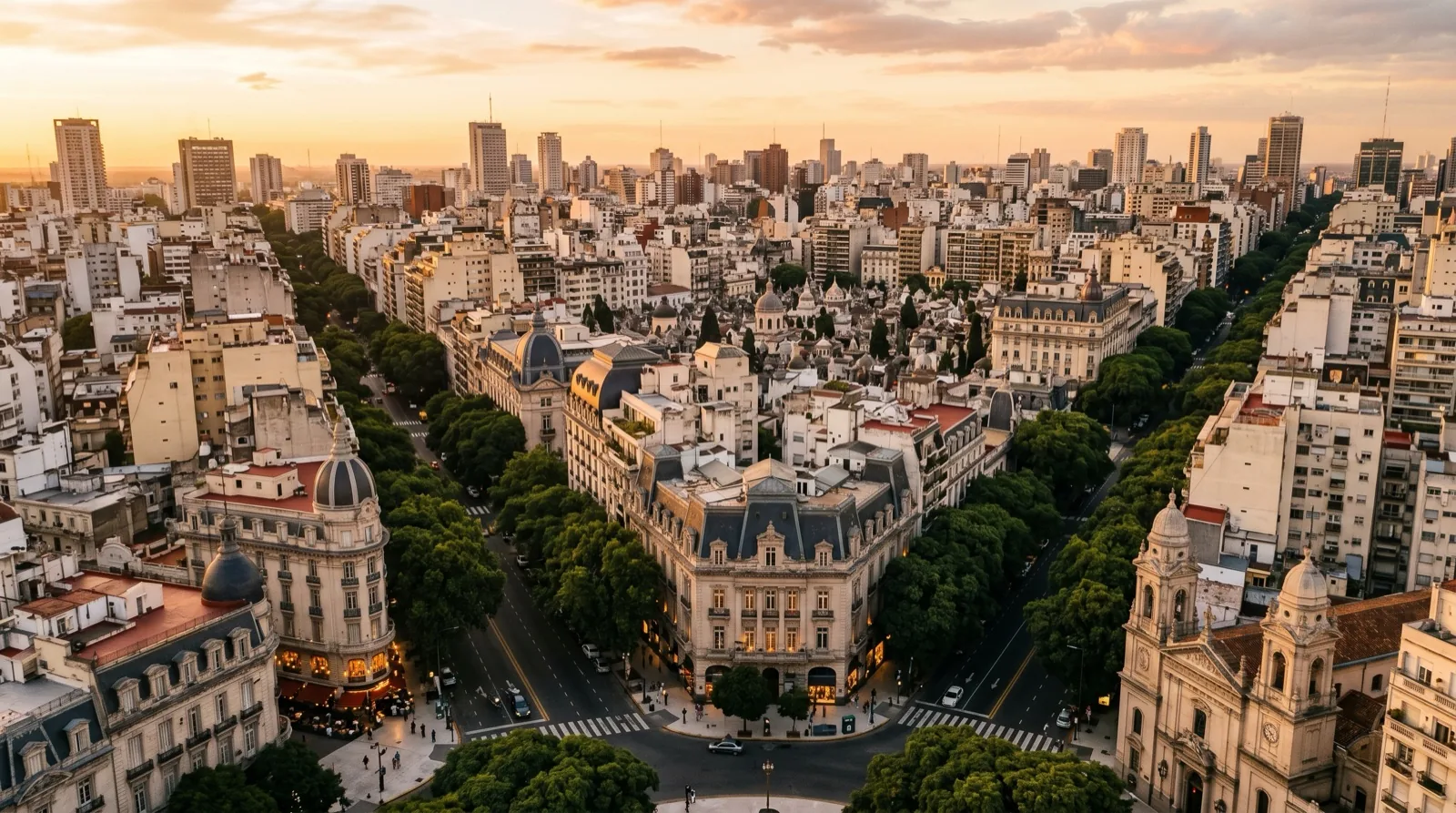
Argentina
Argentina is unicorn-dense, stablecoin-everyday, and post-cepo.
Latin America's third-largest economy by GDP — ~$633–637 billion USD in 2024 — and the home of Globant, MercadoLibre, Auth0, Mural, Tiendanube, and Ualá. Eleven to fourteen unicorns from a population of 46 million is one of the world's highest unicorn-per-capita ratios. The structural backdrop is harder than the unicorn count suggests. Inflation averaged 178% in 2024 — the highest in the world — before the Milei stabilisation programme dragged it to 31.8% by November 2025. The cepo cambiario was partly dismantled on 11 April 2025 with a $1,000–$1,400 ARS/USD currency band; the freelancer-exporter cepo was lifted in September 2025. Eighty-five percent of smartphone-owning Argentines use at least one fintech, and 61.8% of on-exchange crypto purchases are stablecoins — well above the 44.7% global average. That's not a crypto-bro fact. That's a consumer-survival fact: the peso is not a store of value, so Argentines treasury in USDT by default. Globant is now a $2.4B-revenue NASDAQ-listed enterprise SI; everyone smaller wants AI infrastructure at SME prices. Areza ships the six-service stack in rioplatense Spanish, billed in ARS with USD reference or in USD directly, configured for ARCA factura electrónica and BCRA Comunicación 'A' from day one.
Book an Argentina strategy call-
~$633–637B USD
Argentina nominal GDP 2024
Source: IMF World Economic Outlook 2025 / FocusEconomics — LATAM's third-largest economy after Brazil and Mexico; GDP per capita ~$13,422
-
178% → 31.8%
Inflation 2024 → Nov 2025
Source: PIIE 2026 — world's highest inflation in 2024 (178% average); Milei stabilisation programme brought annual to 31.8% by November 2025 — lowest in over seven years
-
11 April 2025; $1,000–$1,400 ARS/USD band
Cepo cambiario partial lift
Source: BCRA — Phase 3 of stabilisation plan launched 11 April 2025; currency band $1,000–$1,400 ARS/USD; BCRA adjusts +1% ceiling / −1% floor monthly; freelancer-exporter cepo lifted September 2025
-
11–14 (highest LATAM density per capita)
Argentine unicorns
Source: Wilson Center 2025 / Bloomberg Línea 2025 — MercadoLibre, Globant, Ualá, Mural, Auth0 (now Okta $6.5B), Tiendanube/Nuvemshop, Bitfarms, Aleph, Vercel (Argentine-founded), Notco, Etermax tier
-
$2,415.7M (+15.3% YoY)
Globant 2024 revenue
Source: Globant Investors Feb 2025 — Buenos Aires HQ, ~27,000 employees globally; 2025 guidance $2,635–2,705M (+9.1–12% YoY); AI Studios + Globant Enterprise AI platform
-
120,000+ (highest English-speaker share in LATAM)
Software developers in Argentina
Source: Hire In South 2026 — Argentina exports ~$8B USD in software services annually; CABA accounts for ~67% of IT-sector employment
-
15–18% adults (→ ~20% early 2026); 61.8% stablecoin on-exchange
Crypto adoption + stablecoin share
Source: Chainalysis 2025 / Blockmanity 2026 / Lemon State of the Crypto Industry 2024 — Argentina's stablecoin share is the highest in LATAM and well above the 44.7% global average; USDT is everyday treasury
-
MELI group $12.6B revenue (+46%); Tiendanube ARS $2T merchant invoicing (+73%)
Mercado Libre + Tiendanube 2025
Source: Business Wire Feb 2026 / NubeCommerce 2026 — MELI Argentine-founded, LATAM-wide, 78M MAU; Tiendanube reached 22M orders (+30%) and 105.6M products (+57%) in 2025
Why Argentina
Four facts about Argentina that change what AI growth has to do.
Unicorn density is structural, not a marketing line. Eleven to fourteen Argentine-founded unicorns from a population of 46 million is one of the highest unicorn-per-capita ratios anywhere outside Israel. Globant is now $2.4B in revenue, NASDAQ-listed, 27,000 employees globally — Argentina's most visible tech export and the dominant LATAM SI.
MercadoLibre runs the most important commerce + fintech infrastructure in LATAM. Auth0 sold to Okta for $6.5B in 2021 — one of the largest LATAM tech exits. Mural and Tiendanube run global SaaS books.
Vercel was founded by an Argentine and still has meaningful Argentine engineering. The talent layer is real: 120,000+ software developers, the highest English-speaker share in LATAM, and a developer-density that compounds because every senior engineer who ships at Globant or MercadoLibre becomes a founder or angel for the next cohort.
The macro backdrop is the wedge for AI-priced services. Argentina ran 178% inflation in 2024 — the highest in the world. The Milei stabilisation programme dragged annual inflation to 31.8% by November 2025. The cepo cambiario was partly dismantled on 11 April 2025 with a $1,000–$1,400 ARS/USD currency band.
The freelancer-exporter cepo was lifted in September 2025, finally letting Argentine engineers and exporters collect USD from foreign clients without forced peso conversion at the official rate. The macro pain compressed budgets for years; the partial recovery is now compressing the gap to global SaaS rates rather than blowing it out.
Argentine senior engineers and strategists bill at roughly 35–55% of San Francisco rates rather than the 20–30% of 2022 when the blue dollar ran at multiples of the official rate. That's the right window for SME-priced AI infrastructure that competes against Globant-tier enterprise envelopes and against US-default SaaS that doesn't know about ARCA factura electrónica or voseo.
Crypto and stablecoins are everyday infrastructure, not crypto-bro positioning. Fifteen to eighteen percent of Argentine adults use crypto and ~20% is projected by early 2026 — among the highest in the world. 61.8% of on-exchange purchase volume is stablecoins — mostly USDT and USDC. That's 17 percentage points above the 44.7% global average.
The structural driver: the peso is not a store of value, so Argentines run informal USDT treasuries by default. Many SMEs invoice cross-border in USDT or settle vendor payments in stablecoins via Lemon, Belo, Buenbit, or Bitso. Vendors who refuse to accept stablecoin settlement (where regulatorily appropriate) leave liquidity on the table for Argentine SMB and Series A+ clients.
Rioplatense Spanish is the operator-level language; voseo is the test. Argentine B2B founders default to vos within minutes. `Vos podés hacerlo` is the rioplatense norm. `Tú puedes hacerlo` reads as Mexican or Spanish translation and immediately signals 'this vendor does not actually serve Argentina'.
The lexical distance from Mexican and Castilian is also load-bearing: `dale` not `sale` or `vale`; `copado` not `chido` or `guay`; `mango` as informal slang for peso.
The contract language signs with `usted` formality in the cover note for traditional family-business mid-market, but operator-level B2B and consumer-facing product surfaces ship in voseo. Castilian Spanish accents in voice agents read as foreign to Argentine ears — the standard configuration uses rioplatense intonation and prosody.
Numbers, not slogans
What the data actually says about Argentine digital buying.
Argentina is the third-largest LATAM tech ecosystem after Brazil and Mexico. The Argentine tech market is projected to grow from ~$22B to ~$45B by 2028 — roughly 19% compound annual growth on a base that already exports $8B in software services.
CABA (the Buenos Aires Autonomous City) plus GBA (Greater Buenos Aires) account for ~67% of IT-sector employment; Córdoba is the secondary engineering pole with Globant's largest non-Buenos-Aires presence and Mercado Libre's Córdoba engineering office; Rosario sits at the intersection of fintech and agribusiness (Bioceres, several agtech founders); Mendoza anchors wine and ag exports.
A single Spanish-language site does not serve all four poles; AI Search citation patterns also vary by pole because the buyer's English-comfort and USD-pricing-comfort differ.
Ecommerce volume hit ~$33B USD in 2024 and is projected to grow at 14% CAGR to ~$50B by 2027. Tiendanube — the dominant ARG SMB DTC platform — saw merchant invoicing grow 73% in 2025 to ~ARS $2 trillion, with stores that sold in both 2024 and 2025 growing 40.2% on average — outpacing Argentina's 31.5% cumulative inflation in real terms. Mercado Libre Argentina alone recorded ~90M monthly web visits in November 2024.
The 2026 NubeCommerce report framed 2026 as 'the era of agentic commerce' — AI agents browsing and buying on behalf of consumers — which is the right framing for what AI Search citation means in an ecommerce context: not just ranking in Google, but being recommended by ChatGPT, Perplexity, and Google AI Overviews when an Argentine consumer asks them to find a product.
Fintech is genuinely mass-market. 85% of smartphone-owning Argentines use at least one fintech; there are 42 million digital-wallet users (+180% vs 2020); ~$95B USD was transacted via fintech in 2024. Ualá raised $300M Series E in November 2024 at a $2.75B post-money valuation led by Allianz X, then closed the Wilobank acquisition to operate as a full bank under BCRA supervision.
Mercado Pago launched its credit card in Argentina in 2025 and initiated a banking-licence process. Nubank announced a Q1 2026 return. The competing rails are crowded — Mercado Pago, MODO, Ualá, Naranja X, Brubank, Reba, Personal Pay — and AI Search citation for `mejor billetera virtual Argentina 2026` is now the structural acquisition channel that affiliate spend used to be.
On AI search: ChatGPT, Perplexity, and Google AI Overviews answer rioplatense-Spanish Argentine queries from a mix of Spanish and English source content, then render in rioplatense Spanish with mixed success — many AI answers slip into Mexican `tú` register or Castilian phrasing because their training data overweights Mexican and Iberian Spanish.
The structural opportunity for Argentine AI buyers is real: rioplatense-Spanish content with proper schema, ARCA-tagged invoicing content, BCRA-aligned compliance pages, and voseo register picks up citation share that Mexican-Spanish or Castilian-Spanish content cannot win in Argentine SERPs.
The competing surface includes Globant's enterprise content, BBVA Argentina + Galicia Más fintech pages, and the long tail of `consulte por su precio` consultancy directories. Areza ships content that competes on the citation surface that Argentine buyers actually see.
What we do differently
An SME-priced six-service stack, in rioplatense Spanish, under ARCA + BCRA from day one.
Areza is built for the Argentine mid-market that Globant cannot serve at price and that US-default SaaS cannot serve at register. Foundation starts at USD $2,400 or ARS $2.9M (~ARS $1,200/USD reference) for a 2–4 week conversion-first build in rioplatense Spanish. AI Search retainer starts at USD $390/month or ARS $470k/month equivalent.
A typical Argentine SME engagement combines Foundation + AI Search + Knowledge Bot, landing around USD $5,500–$8,000 setup plus USD $900–$1,400/month for the first six months. Voice Agent in rioplatense Spanish goes live in 14 days. None of that requires a Globant-tier RFP cycle or a Big-4 procurement runway.
The compliance map is published as part of the engagement, not bolted on later. Ley 25.326 (Argentina's GDPR-equivalent) is administered by AAIP; Argentina holds an EU adequacy decision, which means EU clients can transfer personal data to Argentine processors without SCCs — a real edge for ARG fintech and SaaS selling into EU customers.
We configure Consent Mode v2 with all-denied defaults, set EU or Argentine data residency on request, sign DPAs at engagement start, and include explicit no-training-on-customer-data terms.
For BCRA-supervised neobanks and CNV-supervised crypto exchanges, we add the regulator-specific reporting workflows to scope at the start rather than at the surprise stage. For clients above ARS $X annual spend we invoice via an Argentine ARCA partner with the correct CAE flow so AP teams do not route to international-wire purgatory and finance does not push back.
We ship rioplatense, not Mexican or Madrid Spanish. The Spanish surfaces use vos register on operator-facing screens and usted on legal disclaimers, finance pages, and traditional family-business mid-market first-contact. Voice Agent uses rioplatense intonation and prosody — Castilian and Mexican accents are filtered out of the standard configuration because Argentine ears clock them as foreign.
Sector-specific scripts cover BCRA-supervised neobanks, CNV-supervised crypto exchanges, AAIP data-protection requirements, ARCA factura electrónica flows, and SENASA-compliant agribusiness operators. For LATAM-expanding Argentine clients we ship distinct LATAM-Spanish variants — Mexican Spanish, Colombian Spanish, Chilean Spanish — kept properly separate from the rioplatense base.
Timezone coverage is built in. The team operates with overlap to GMT-3 (Argentine standard time) and GMT-5 / GMT-4 (US Eastern / Central) — the dominant working hours for CABA, Córdoba, Rosario, Mendoza, and the US-buyer-facing flows most Argentine clients eventually serve. That means same-business-day async response during the Argentine workday rather than the 4–6 hour Europe-Argentina lag that EU-only agencies impose.
For Argentine clients selling into the US (a common pattern at Series A+) we configure bilingual ES-AR + EN-US content with hreflang `es-AR` + `en-US` set correctly, so the US buyer searching for an Argentine vendor finds the English page and the Argentine operator finds the Spanish page without either rendering the wrong locale.
Niches
Where Areza fits in Argentina, by niche.
Each niche page goes deep on the local operator pattern — named tools, sourced ROI, regulatory specifics, and the Areza service mapping that works inside that vertical.
-
B2B SaaS (CABA + Córdoba)
CABA + Córdoba scale-ups raising USD rounds, voseo-default internally, English-default at the senior-engineer level. The cluster includes Globant alumni, MercadoLibre alumni, Auth0 / Mural / Tiendanube founders, Pomelo, Olivia, Increase, plus the long tail of Series A SaaS in Palermo / Recoleta. The wedge is bilingual ES-AR + EN-US AI-search citation infrastructure while the GTM team scales into LATAM and the US.
Fit for Series A–B Argentine SaaS scale-ups, 30–200 FTE, dual-locale rioplatense Spanish + English buyer base.
Read the deep-dive -
Ecommerce + DTC
Argentine ecommerce hit ~$33B USD in 2024 and is projected to reach ~$50B by 2027 at 14% CAGR. The brand tail runs on Tiendanube / Nuvemshop (dominant ARG SMB DTC), VTEX (enterprise), MELI Mercado Shops, and Shopify. The 2026 NubeCommerce report calls it 'the era of agentic commerce'. The wedge is AI-search citation for `mejor marca de [categoría] Argentina` queries plus Voice Agent in rioplatense Spanish for post-purchase support and Mercado Pago dispute handling.
Fit for Argentine DTC brands ARS $200M–$10B ARR; Tiendanube, VTEX, MELI Plus, or Shopify stacks.
Read the deep-dive -
Fintech (CABA + Rosario)
Argentina has one of the world's highest fintech-penetration rates: 85% of smartphone-owning Argentines use at least one fintech and 42M+ digital-wallet users. Ualá raised $300M at a $2.75B valuation in November 2024 and operates as an Argentine bank. Mercado Pago is initiating a banking-licence process. Crypto adoption sits at 15–18% of adults with 61.8% of on-exchange volume in stablecoins. Nubank returns Q1 2026. The wedge is rioplatense AI Search + Voice Agent + Knowledge Bot for BCRA + CNV + UIF + AAIP compliance.
Fit for CABA + Rosario fintech scale-ups, 20–300 FTE, under BCRA Comunicación 'A' + CNV + UIF supervision.
Read the deep-dive -
Agribusiness (Pampas + Rosario)
Argentina is the world's #3 soybean exporter and #2 corn exporter; beef exports hit 935,261 metric tons in 2024 — the highest in a century — with ~70% to China. Bioceres' HB4 drought-tolerant seed delivers 20–43% yield gains in dry plots and Brazil's 2024 approval unlocked a 40M-hectare regional market. Kilimo has saved 72B+ litres of water across seven countries with Microsoft, Unilever, and Coca-Cola as customers. Auravant ships precision-ag SaaS globally. The wedge is bilingual AI Search + Workflow Ops for SENASA-compliant operators and global ESG offtake buyers.
Fit for 5,000–50,000 ha Pampas operators, ARG-founded agtech SaaS, and SENASA-aligned beef + grain processors.
Read the deep-dive -
Professional services
Argentine despachos — estudios jurídicos, contadores, consultoras fiscales — operate under ARCA factura electrónica, AAIP data protection, and a uniquely complex tax regime (IVA + Ganancias + Bienes Personales + Ingresos Brutos provincial + IIBB municipal + Cheques + Impuesto País). Top tier includes Marval O'Farrell Mairal, Bruchou & Funes de Rioja, Beccar Varela (>125 years), Pérez Alati; the long tail is single-partner and 2–10 partner boutiques in CABA, Rosario, Córdoba, Mendoza. The SME wedge is rioplatense AI Search citation + Knowledge Bot for client FAQ around ARCA changes, plus Foundation pages tuned for `consultoría tributaria Argentina` long-tail.
Fit for 1–80 FTE despachos under Colegios + ARCA + AAIP + sectoral regulators.
Read the deep-dive




Cultural + regulatory
How Argentine operators actually buy.
Ley 25.326 + AAIP set the data-protection floor; there is no standalone AI law yet. The Ley de Protección de los Datos Personales (Ley 25.326, in force since 2000) is administered by AAIP (Agencia de Acceso a la Información Pública). Argentina holds an EU adequacy decision — one of two LATAM countries with this status, alongside Uruguay — which means EU clients can transfer personal data to Argentine processors without standard contractual clauses.
A reform package has been pending in Congress since 2022 to align with GDPR 2.0 and recognise sensitive AI processing categories; passage has been pushed by the post-Milei legislative recess.
There is no Argentine equivalent of the EU AI Act yet, and the post-Milei executive posture is deliberately permissive — Resolución 161/2023 set non-binding AI ethics guidance, but enforcement is light. We configure data and AI compliance at engagement start: documented sub-processor list, no-training-on-customer-data clauses, Consent Mode v2 with all-denied defaults, and either Argentine, EU, or Mexican data residency on request.
ARCA (formerly AFIP) factura electrónica is the procurement gate. AFIP was rebranded ARCA (Agencia Recaudadora y de Control Aduanero) on 21 October 2024. Every Argentine invoice — Tipo A between IVA-registered taxpayers, Tipo B to consumidor final, Tipo C for monotributistas, Tipo M for high-risk, Tipo E for export — needs a CAE (Código de Autorización Electrónico) from ARCA before issuance; without the CAE the invoice is invalid.
RG 5614/2024 + RG 5616/2024 (December 2024) tightened metadata requirements and CAE issuance SLA.
A vendor that cannot issue valid factura electrónica with the correct CAE flow does not get paid by an Argentine mid-market AP team — the invoice gets routed to international-wire purgatory and finance pushes back. We invoice via an Argentine ARCA partner on request for clients above ARS $X annual spend, with the correct factura type for the buyer's tax category.
Rioplatense Spanish, not Mexican or Castilian. The lexical differences matter for SEO and AI Search. `Computadora` is Argentine + Mexican; `ordenador` reads as Iberian. `Celular` is Argentine + Mexican; `móvil` is Iberian. The load-bearing distinction is voseo: `vos podés` (Argentine) vs `tú puedes` (Mexican / Castilian).
Voseo is the operator-level norm in product-led B2B and in CABA / Rosario / Córdoba / Mendoza. `Tú` reads as foreign — Argentine readers immediately clock it as Mexican or Castilian translation.
The contract still signs with `usted` formality in the cover note for traditional family-business mid-market, but consumer-facing product surfaces and operator-level B2B run in voseo. Lexical markers: `dale` (acknowledgement), `bárbaro` / `copado` / `piola` (positive), `quilombo` (mess), `boludo` / `che` (informal address — used between peers but not in B2B copy).
Crypto and stablecoin literacy is mid-market table-stakes. Fifteen to eighteen percent of Argentine adults use crypto and 61.8% of on-exchange purchase volume is stablecoins — vs 44.7% global average. The pattern is not crypto-bro positioning.
The peso lost most of its purchasing power between 2018 and 2024; Argentine SMEs and households run informal USDT treasuries by default. Many Series A+ founders pay foreign contractors in USDT via Lemon, Belo, Buenbit, or Bitso; some Argentine SMEs accept USDT settlement from cross-border clients.
Vendors who refuse stablecoin settlement where regulatorily appropriate leave liquidity on the table for Argentine SMB and Series A+ clients. We accept USD via bank transfer, ARS via local rail with valid factura electrónica, and (case by case) USDT for cross-border engagements where the legal frame supports it.
Cepo cambiario complications are still real after the partial 2025 lift. The currency band of $1,000–$1,400 ARS/USD launched on 11 April 2025 made USD purchase legal again for individuals and businesses.
The freelancer-exporter cepo was lifted in September 2025, finally letting Argentine engineers and exporters collect USD from foreign clients without forced peso conversion at the official rate. But in September 2025 the BCRA reinstated a 90-day cross-restriction: buyers of official-rate USD cannot operate MEP or CCL for 90 days afterwards.
Series A+ founders price in USD by default; family-business mid-market expects ARS proposals with a USD reference rate and quarterly FX adjustment clauses. We invoice in ARS with USD reference for ARG-domestic clients, and in USD for US-buyer-facing engagements where the contract anchors to a Delaware or EU entity.
Decision pace is bimodal: Series A+ fast, family-business slow. Series A+ Argentine SaaS and fintech founders move in 30–60 day cycles — less procedural than EU enterprise, often comparable to US Series A pace. Traditional family-business mid-market — food, agro, packaging, construction — moves in 4–8 month cycles dominated by the patriarch and a US-trained next-gen operator.
Big-4 + Globant-tier enterprise procurement runs 6–12 months. We start with Foundation engagements so Series A+ founders see output inside 30 days, and we structure retainers in ARS with USD reference or in USD directly so quarterly inflation and FX swings do not blow up the engagement P&L.
Examples
How operators in Argentina actually use Areza.
-
Buenos Aires Series B SaaS scaling into the US (Palermo Soho)
A 120-person Palermo SaaS scaling into the US needed to compete in both `software pyme Argentina IA` rioplatense-Spanish queries and `[category] platform for SMEs` English-language US queries while a six-person GTM team scaled to twelve. Foundation refresh in 3 weeks — bilingual ES-AR + EN-US site with `es-AR` and `en-US` hreflang set correctly, voseo register on product pages, English-default on developer docs and pricing. Added AI Search retainer targeting fourteen cluster queries split evenly between rioplatense Spanish and English. Voice Agent for inbound demos in rioplatense with English-overlay for US prospects. Three months in: ChatGPT and Perplexity citations on 9 of 14 target queries, 31% of demo bookings AI-search-referred, GTM able to defer hiring a third SDR by one quarter. Voice Agent handled 67% of inbound demo qualification end-to-end. The compounding lever: the rioplatense voseo register made the brand sound authentically Argentine to LATAM Spanish-speaking US Hispanics — a second-order acquisition signal the Mexican-Spanish or Castilian-Spanish content from US competitors could not reproduce.
-
Rosario agtech scale-up selling to Microsoft + Unilever sustainability buyers
A 45-person Rosario agtech (Kilimo-adjacent pattern) sold AI-driven irrigation optimisation to global corporate sustainability buyers — Microsoft, Unilever, Coca-Cola — as volumetric water benefits for water-neutrality programmes. The buyer side wanted en-US English with corporate sustainability reporting schema; the Argentine producer side ran rioplatense Spanish and bilingual technical docs. Foundation built a tri-locale site (es-AR for Argentine producers, es-MX/es-CO/es-CL for LATAM expansion, en-US for global corporate sustainability buyers) with separate hreflang targeting per locale. AI Search retainer targeted `volumetric water benefit Argentina`, `corporate water neutrality LATAM agriculture`, and `precision agriculture SaaS LATAM` English queries plus `riego inteligente IA Argentina` and `agricultura de precisión pampas` Spanish queries. Workflow Ops automated MRV (measurement-reporting-verification) reports for corporate ESG offtake contracts. Knowledge Bot trained on SENASA + INTA + global ESG reporting standards. Six months in: ChatGPT citations on 6 of 8 corporate-sustainability English queries, two new Fortune 500 sustainability buyers cited the company specifically in their net-zero plans, and Argentine-producer-side inbound from `riego inteligente IA Argentina` queries doubled. The patron-corporate offtake structure turned non-farm sustainability revenue into the primary growth engine while the Argentine operator base compounded in parallel.
-
CABA fintech under BCRA + CNV + UIF (Roma Norte equivalent: Palermo)
A 95-person CABA consumer-credit fintech regulated under BCRA Comunicación 'A' + CNV + UIF needed to compete against Galicia Más / Naranja X and BBVA Argentina on rioplatense-Spanish acquisition queries while shipping every consumer surface AAIP-compliant. Foundation rewrote the product pages in rioplatense Spanish with vos register for the Gen Z + Millennial product-led screens and usted for the legal disclaimers and CFT (consumer financial transparency) sections. AI Search targeted `mejor préstamo personal sin Veraz Argentina`, `tarjeta sin sueldo Argentina`, and `billetera virtual sin comisiones` clusters. Knowledge Bot trained on BCRA Comunicación 'A' requirements, CNV crypto-VASP guidelines (Resolución 994/2024 + 1058/2024), and UIF AML reporting cadences with strict no-advice disclaimers and human handoff at any wealth-suitability touch. Three months in: ChatGPT citations on 5 of 7 product-page clusters, 38% reduction in 'wait, what does this mean?' support tickets after Knowledge Bot deployment, and a BCRA inspection passed with zero findings on consumer-surface transparency. The structural insight: rioplatense-Spanish AAIP-compliant content with proper schema beat the Castilian-Spanish content the BCRA's own auditors were referencing — citation share compounded inside a single quarter.
Let's build the foundation your business actually deserves.
Frequently asked
-
Do you deliver in rioplatense Spanish or Mexican/Castilian Spanish?
Rioplatense Spanish (es-AR) — voseo register on operator-facing screens, usted on legal disclaimers and family-business mid-market first contact. All client-facing surfaces — website, sales materials, Voice Agent, customer support copy, Knowledge Bot, email templates — ship in rioplatense Spanish with rioplatense lexicon. `Vos podés`, not `tú puedes`. `Dale`, not `sale` or `vale`. `Computadora`, not `ordenador`. `Celular`, not `móvil`. Voice Agent uses rioplatense intonation and prosody — Mexican and Castilian accents are filtered out of the standard configuration because Argentine ears clock them as foreign. For LATAM-expanding Argentine clients we ship distinct LATAM-Spanish variants — Mexican Spanish, Colombian Spanish, Chilean Spanish — kept properly separate from the rioplatense base. Strategic work and schema architecture are designed in English internally and delivered as rioplatense Spanish artefacts.
-
Can you issue ARCA factura electrónica with valid CAE? What about the new RG 5614/2024 + 5616/2024?
Yes. For Argentine clients above ARS $X annual spend we invoice via an Argentine ARCA partner with the correct factura type for the buyer's tax category — Tipo A between IVA-registered taxpayers, Tipo B to consumidor final, Tipo C for monotributistas, Tipo E for export, Tipo M for high-risk. Every invoice gets a valid CAE from ARCA before issuance; without the CAE the invoice is invalid and the AP team will not pay. RG 5614/2024 and RG 5616/2024 (December 2024) tightened metadata requirements and CAE issuance SLA — our partner stack was rebuilt against the new schema in January 2025. Below the threshold we invoice cross-border in USD with a clear note that the buyer should request an ARCA mirror invoice from their tax adviser if procurement requires one.
-
How do you handle the cepo cambiario and peso volatility in pricing?
We invoice in ARS with a USD reference rate by default for Argentine domestic clients; in USD for US-buyer-facing engagements anchored to a Delaware or EU entity; and (case by case) in USDT for cross-border engagements where the legal frame supports it and the client requests it. The April 2025 cepo lift launched a currency band of $1,000–$1,400 ARS/USD with BCRA adjusting +1% ceiling / −1% floor monthly. The September 2025 freelancer-exporter cepo lift made USD billing legal for Argentine freelancers receiving USD from foreign clients. In September 2025 BCRA reinstated a 90-day cross-restriction: official-rate USD buyers cannot operate MEP or CCL for 90 days. We absorb FX inside the retainer envelope for ARG-domestic clients within the engagement scope; if inflation or the peso swings outside the band we re-anchor pricing at the quarterly review, not mid-engagement.
-
What is the EU adequacy decision and why does it matter?
Argentina holds an European Commission adequacy decision (Decision 2003/490/EC) — one of only two LATAM countries with this status, alongside Uruguay. Practical effect: EU companies can transfer personal data to Argentine processors without standard contractual clauses, and Argentine fintech or SaaS selling into EU customers can structure data processing agreements without the additional SCC layer that Mexican or Brazilian processors require. For Argentine clients selling into the EU, this is a real commercial edge: a Spanish or German enterprise buyer can onboard an Argentine processor faster than they could onboard a Mexican or Brazilian one with equivalent technical capability. We configure DPAs, sub-processor lists, and no-training-on-customer-data clauses on every engagement, with EU residency available on the inference layer when the client's customer base requires it.
-
Do you support CABA, Córdoba, Rosario, and Mendoza differently?
Yes. CABA + GBA is the centre of gravity for fintech and Series A+ SaaS — Palermo, Recoleta, Belgrano, Puerto Madero cluster pattern; voseo dominant, English-default at the founder + senior-engineer level; largest deal sizes, faster than family-business mid-market on first decision but slower than US Series A. Córdoba is the engineering pole — Globant's largest non-CABA office, Mercado Libre's engineering centre; lower cost than CABA, faster decision cycles, voseo + English. Rosario sits at the intersection of fintech and agribusiness — Bioceres, several agtech founders, the soybean-export corridor; family-business decision-making with US-trained next-gen operator buying alongside the patriarch. Mendoza anchors wine and ag exports; smaller tech ecosystem but real B2B software adoption. Sector events differ per pole — Sysarmy + Nerdearla in CABA, EkoParty hacker conference, Expoagro in San Nicolás for agribusiness, Wine + Wineries conferences in Mendoza.
-
How fast can a Voice Agent in rioplatense Spanish go live? Does it handle voseo correctly?
14 days from kick-off for the standard configuration: inbound handling, qualification, calendar booking, CRM hand-off, and outbound reminders in rioplatense Spanish with voseo register. Add a week for English-overlay (the standard for Argentine SaaS or agtech selling into the US). Add two weeks for sector-specific compliance scripts — BCRA Comunicación 'A' for neobanks, CNV for crypto VASPs, AAIP for any consumer-data flow, SENASA for agribusiness operators, ARCA factura electrónica consultations for despachos. The 14-day baseline assumes you can provide your call recordings, FAQs, and the names of the three buyer questions you hear most often. Voice Agent operates with GMT-3 (Argentina), GMT-5 / GMT-4 (US Eastern / Central), and GMT-6 (US Central / LATAM expansion) overlap built in so US-buyer inbound calls during California or Texas business hours route correctly without an 8-hour Europe lag.
-
Do you accept USDT or stablecoin payment?
Yes, case by case, for cross-border engagements where the legal frame supports it and the client requests it. Argentina has one of the world's highest crypto-adoption rates (15–18% of adults, ~20% projected early 2026) and 61.8% of on-exchange purchase volume is stablecoins — mostly USDT and USDC. Many Argentine SMEs run informal USDT treasuries by default because the peso is not a store of value. Where the contract anchors to an EU or Delaware entity and the client prefers USDT/USDC settlement, we accept stablecoin payment via Lemon, Belo, Buenbit, or Bitso. For Argentine-domestic clients invoiced through an ARCA partner, settlement is ARS via local rail. We do not encourage crypto-only engagements — the legal frame around VASP (Virtual Asset Service Provider) registration in Argentina is still in flux under CNV Resolución 994/2024 + 1058/2024 and we wait for client counsel sign-off on the structure.
-
How does Areza differ from Globant, Big-4 advisory, or an Argentine boutique?
Globant, Accenture, IBM, Capgemini, NTT Data, and the Big-4 Argentina open enterprise envelopes above USD $200,000–$500,000 with 8–25 FTE delivery teams — they are excellent for IPC-tier banks, Big-Cap insurers, and YPF / Telecom / Galicia-scale procurement. Argentine boutiques (Hexacta, Baufest, 10Pines, Bixlabs, NaaT Tech) compete on price for mid-market projects and are strong on rioplatense delivery. Areza is built for the AI-search + agentic-automation + voice layer — the parts of B2B growth that are remote-first, systems-engineering-shaped, configured for AAIP + ARCA from day one, and priced for the mid-market scale-ups that the Globant-tier envelope filters out. The honest split: hire Globant or Accenture for Galicia / Telecom / YPF-scale transformation, an Argentine boutique for one-off Spanish-language content work, and bring Areza in for the AI Search, Voice Agent, Workflow Ops, and Knowledge Bot work where the systems-first approach compounds and the SME-priced six-service stack closes the gap that USD $200K+ Globant quotes cannot touch.
Where to start
Services that fit Argentina.
- AI Search
The single highest-impact service for Argentine scale-ups — bilingual rioplatense-Spanish + English citation infrastructure that competes against Globant-tier directories and Mexican/Castilian content for `agencia de IA Argentina` and `[category] platform Argentina` long-tail queries.
- Foundation
Rioplatense conversion-first build in 2–4 weeks from USD $2,400 / ARS $2.9M. The prerequisite for AAIP-compliant trust signals, ARCA factura electrónica procurement pages, and voseo/usted-calibrated sales surfaces.
- Voice Agent
Native rioplatense Spanish voice agent live in 14 days with optional English-overlay for US-buyer-facing engagements. Closes the 60-second response gap for Argentine SME inbound and Series A+ US-buyer follow-up.
- Workflow Ops
ARCA factura electrónica + CAE flow + BCRA Comunicación 'A' reporting + CNV crypto-VASP filings + UIF AML cadence without an in-house ML team. Solves the regulatory-adaptation tax that filters Globant-tier quotes out at price.
- Knowledge Bot
Rioplatense-first internal knowledge surface trained on AAIP, ARCA, BCRA, CNV, UIF, SENASA + sector-specific rules. Cuts AP and customer-service ticket load without violating Ley 25.326 confidentiality.
- Growth Stack
End-to-end bundle for Series A+ scale-ups: Foundation + AI Search + Voice Agent + Workflow Ops + Knowledge Bot configured for CABA + Córdoba + Rosario GTM with LATAM-Spanish + en-US bilingual coverage.
Further reading
On AI search + Nordic buyers.
Reviewed by Nikita Janockin, Founder · Last updated 17 May 2026
Sources (8) →
- IMF World Economic Outlook 2025 / FocusEconomics — LATAM's third-largest economy after Brazil and Mexico; GDP per capita ~$13,422
- PIIE 2026 — world's highest inflation in 2024 (178% average); Milei stabilisation programme brought annual to 31.8% by November 2025 — lowest in over seven years
- BCRA — Phase 3 of stabilisation plan launched 11 April 2025; currency band $1,000–$1,400 ARS/USD; BCRA adjusts +1% ceiling / −1% floor monthly; freelancer-exporter cepo lifted September 2025
- Wilson Center 2025 / Bloomberg Línea 2025 — MercadoLibre, Globant, Ualá, Mural, Auth0 (now Okta $6.5B), Tiendanube/Nuvemshop, Bitfarms, Aleph, Vercel (Argentine-founded), Notco, Etermax tier
- Globant Investors Feb 2025 — Buenos Aires HQ, ~27,000 employees globally; 2025 guidance $2,635–2,705M (+9.1–12% YoY); AI Studios + Globant Enterprise AI platform
- Hire In South 2026 — Argentina exports ~$8B USD in software services annually; CABA accounts for ~67% of IT-sector employment
- Chainalysis 2025 / Blockmanity 2026 / Lemon State of the Crypto Industry 2024 — Argentina's stablecoin share is the highest in LATAM and well above the 44.7% global average; USDT is everyday treasury
- Business Wire Feb 2026 / NubeCommerce 2026 — MELI Argentine-founded, LATAM-wide, 78M MAU; Tiendanube reached 22M orders (+30%) and 105.6M products (+57%) in 2025