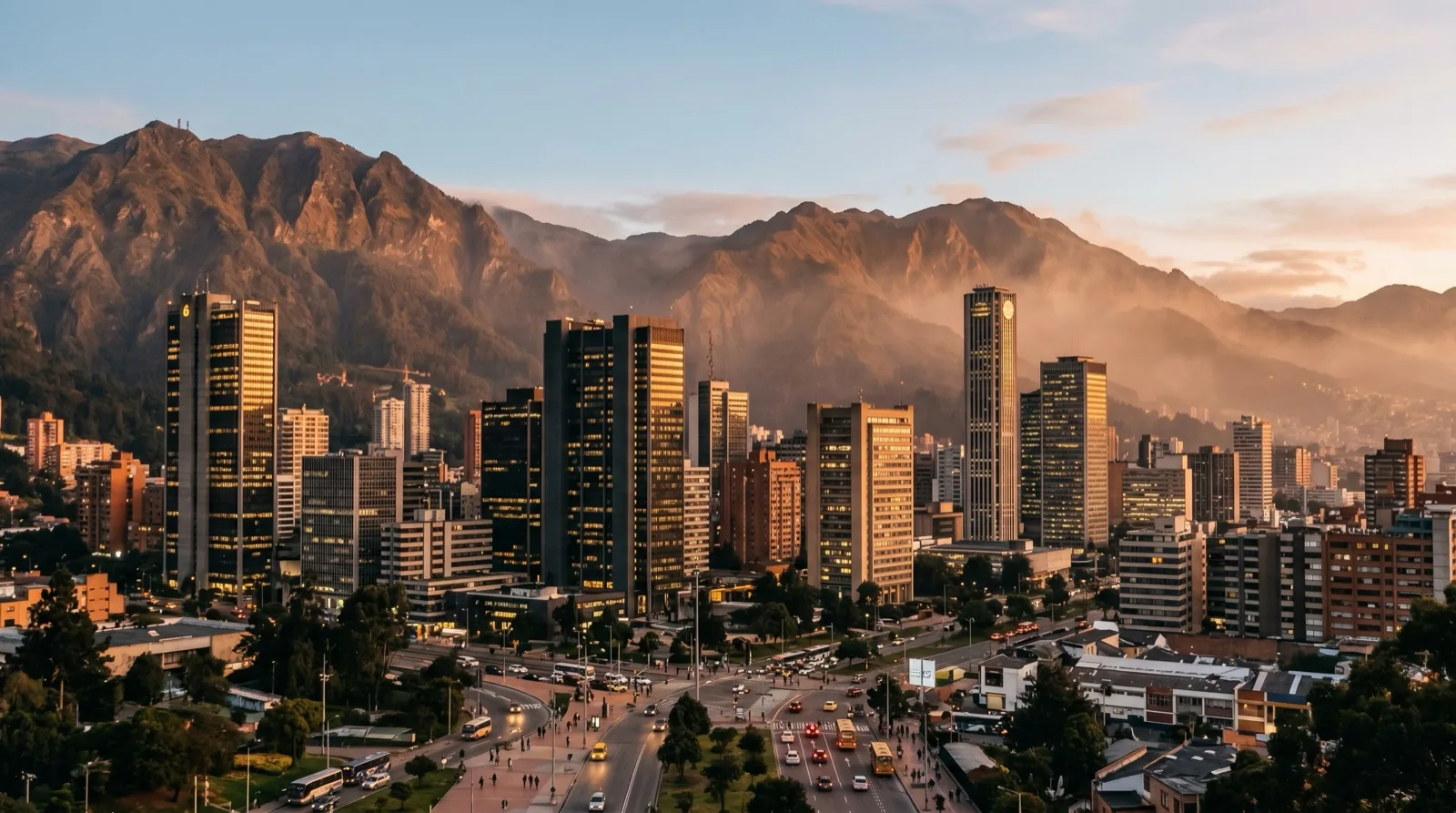
Colombia
Colombia is the US nearshore engineering hub, and LATAM's fastest-growing VC market.
$418B USD GDP, fourth-largest economy in Latin America, and the fastest-growing VC market in LATAM with +36.3% YoY venture growth in 2024 — outpacing Brazil (+7.9%) and Mexico (+2.8%). Bogotá is the third-largest IT hub in Latin America with 760 startups and is one US Eastern time-zone away from Atlanta, Miami, and New York. Then the structural fact most US buyers are starting to act on: a senior software engineer at Globant Colombia tops out around USD $42k base, against $150k+ for an equivalent role in the US. The result is the most active LATAM nearshoring corridor of the decade. The fintech stack is mature — Nequi (24M users) plus Daviplata (19M) plus Nu Colombia (4M, doubled in 12 months) — and DIAN Facturación Electrónica is mandatory across B2B, B2C, B2G. SIC Circular 002/2024 sets binding AI guidance under Habeas Data Law 1581/2012, with the SIC already ordering Worldcoin out of Colombia in October 2025 over biometric consent. We close the Tier-1 consulting price gap with the six-service Areza stack, priced in COP or USD, delivered in Colombian Spanish, configured for DIAN + Habeas Data + SIC AI circulars from day one.
Book a Colombia strategy call-
$418.5B USD
Colombia GDP 2024 (nominal)
Source: World Bank 2024 — fourth-largest Latin American economy after Brazil, Mexico, Argentina
-
+36.3% YoY (vs Brazil +7.9%, Mexico +2.8%)
Colombia VC growth 2024
Source: Galileo Financial Technologies 2025 — fastest-growing LATAM VC jurisdiction in 2024
-
1,074 new firms (+12% YoY)
Bogotá tech company formation 2024
Source: BBVA Spark Colombia Tech Report 2024 — third-largest IT hub in Latin America with ~760 startups overall
-
400+ active companies · revenue tripled in four years
Colombian fintech sector
Source: Finnosummit Fintech Radar Colombia 2025 — third-largest fintech market in LATAM after Brazil and Mexico, 66% AI adoption inside fintech
-
46M+ across Nequi (24M) + Daviplata (19M) + Nu (4M) + others
Colombia digital-banking users 2025
Source: Fintech News Americas 2025 — Nequi leads, Daviplata second, Nu Colombia doubled in 12 months, Movii + RappiPay + Lulo Bank + Ualá completing the pyramid
-
COP 65.4M–197M/year (~USD $14k–$42k base)
Globant Colombia senior engineer comp range
Source: Levels.fyi 2026 — 3-4× cheaper than US comparable senior comp of $150k+; nearshoring saves up to 55% net of overhead per Alcor 2025
-
77% of large firms plan to expand AI budget · 57% report tangible benefits
Colombian enterprise AI plans 2025-2026
Source: SAP LATAM Regional AI Report June 2025 — Colombia ranks second LATAM (53%) for AI training investment, behind Brazil (62%)
-
USD $470M (+27% YoY)
Mercado Libre Colombia 2025 investment
Source: Mercado Libre press 2025 — 8M Colombian users, 73,000 sellers, 110M packages shipped; group revenue USD $28.9B (+39% YoY) per Portafolio
Why Colombia
Four facts about Colombia that change what AI growth has to do.
The nearshoring corridor is the structural story, not the slogan. Bogotá is UTC-5 — same as US Eastern most of the year — and Medellín tracks the same offset. A senior software engineer at Globant Colombia tops out around USD $42k base; the US equivalent senior role is $150k+. Mid-level Colombian developers run ~$37k; lead engineers ~$66k.
Nearshore-vs-US savings ladder out to about 55% net of overhead per Alcor 2025. That is the single largest cost arbitrage in any LATAM market that also gives the buyer same-day-meeting time-zone overlap. The result is that Bogotá and Medellín now anchor US-buyer engineering delivery the same way Querétaro and Bajío anchor US-buyer manufacturing.
AI buying in this market frequently rides on top of a nearshore engagement — an English-language capability site for a US prospect, a bilingual support surface for the US client base, a Colombian-Spanish onboarding flow for the Bogotá hiring team. That is a different sales motion from EU enterprise AI, where the AI project is the project.
The fintech rails are mature. The Tier-1 price gap is the wedge. Nequi, Daviplata, Nu Colombia, Movii, Bold, Truora, Treinta, RappiPay and the rest of the 400+ Colombian fintech roster have already built the consumer rails — 46M digital-banking users, PSE for online bank transfers, QR + biometric KYC, instant Nequi-to-Daviplata transfers.
The gap is in mid-market application: an SME in Medellín or Cali running ten people on Excel + WhatsApp + Mercado Libre is not buying USD $250k Tier-1 transformations from Accenture or Globant Consulting. Bogotá AI boutiques publish project rates of COP $4M–$12M for full builds (~USD $850–$2,500); we slot into that bracket with productised AI Search + Voice Agent + Knowledge Bot retainers priced in COP with USD reference.
Bogotá, Medellín, Cali — three operator cultures, one Colombian Spanish. Bogotá is corporate-HQ Colombia — finance, government, legal, fintech HQs, slower committees, larger tickets, highest ChatGPT and Perplexity penetration, formal `usted` register through procurement.
Medellín is engineering + design + paisa-pragmatic — Globant, Tek Experts, dozens of nearshore shops; faster cycles, English-default at senior engineering, `vos` informally inside paisa teams. Cali is salsa, agro, and emerging tech — Truora's hometown, growing fintech + KYC supply chain, smaller market but more relationship-driven sales.
Colombian Spanish is unusually neutral across all three — high-prestige accent across LATAM, suitable for voice agents serving Mexico City to Buenos Aires audiences. One language file fits all three cities, but the GTM motion differs.
Habeas Data + SIC Circular 002/2024 set the AI procurement floor; DIAN sets the payment gate. Law 1581/2012 anchors data protection; the Superintendencia de Industria y Comercio (SIC) runs sanctions, with 2024 sanctions up 22% YoY.
Circular 002/2024 issued binding guidance on AI — proportionality, risk management, impact assessments for high-risk systems, data quality, security techniques like differential privacy. Circular 001/2025 covers fintech consent + KYC. The SIC ordered Worldcoin to cease Colombian operations in October 2025 after biometric-consent failures with ~2M Colombians.
DIAN Facturación Electrónica is mandatory for B2B + B2C + B2G; UBL 2.1 XML with mandatory QR; POS transactions over 5 UVT (~COP 235,000 / ~USD 50) require full e-invoice; non-compliance fines up to 1% of invoice value or 30-day closure. We configure both at engagement start.
Numbers, not slogans
What the data actually says about Colombian digital buying.
Colombia is the fastest-growing LATAM venture market — +36.3% in 2024 against Brazil's +7.9% and Mexico's +2.8% — driven by fintech, B2B SaaS, and proptech.
Rappi (Bogotá-HQ, $5.25B valuation) is the regional super-app reference; Habi is the proptech unicorn; Bold (Bogotá, $70M raised) is the POS rail for ~100k Colombian small merchants; Simetrik is the canonical B2B SaaS reconciliation tool used inside Rappi, Daviplata, and dozens of LATAM fintechs. The 211 AI companies catalogued in Colombia in May 2025 by Tracxn include Truora (KYC), Treble.ai (WhatsApp Business automation), and Ruedata (agriculture data).
The buyer expectation in 2026: a vendor that cannot integrate with DIAN Facturación Electrónica via Siigo or Alegra, cannot price-quote in COP with USD reference, and cannot show Habeas Data compliance with SIC Circular 002/2024 alignment gets filtered out at the second call.
Colombian ecommerce closed 2025 at COP $145.4 trillion (~USD $34B) — +20% YoY per the Cámara Colombiana de Comercio Electrónico. Mercado Libre committed USD $470M to Colombia in 2025 (+27% vs 2024), with 8M Colombian users, 73,000 sellers, and 110M packages shipped.
Mercado Libre group revenue hit USD $28.9B (+39% YoY) in 2025. Bold, Wompi, ePayco, PSE, Nequi QR, and Daviplata QR form the consumer-payment rail layer. DIAN Facturación Electrónica via Siigo, Alegra, or DIAN's free tool is mandatory; the AP queue at any mid-market Colombian buyer routes invoices through this gate.
A vendor selling AI infrastructure or voice agents into Colombian DTC needs to understand that the customer journey routes through Mercado Libre listings, Mercado Libre Ads, WhatsApp Business, and Nequi-QR-at-checkout — not only owned Shopify, VTEX, or Tiendanube storefronts.
Published Bogotá + Medellín AI agency rates run COP $4M–$12M for full builds at the boutique tier and COP $30M–$120M for mid-market builds at established shops, with hourly rates typically COP $200k–$450k (~USD $42–$96).
Nearshore engineering rates for senior Colombians billed to US clients run USD $40–$80/hour fully-loaded — roughly half US East-Coast and one-third San Francisco rates. Pricing transparency is a strong Colombian SME signal in a way it is not in Bogotá corporate procurement: family businesses appreciate a fixed COP envelope they can show the gerente general on a single page.
The Tier-1 `consulte por su precio` posture reads as `this is going to be expensive and political`. Areza publishes prices in COP with USD reference and ships proposals as fixed-fee envelopes, not time-and-materials estimates.
On AI search: ChatGPT, Perplexity, and Google AI Overviews answer Spanish-language Colombian queries from a mix of Spanish and English source content. A Medellín procurement manager researching `agencia de IA Colombia` is plausibly served a Perplexity answer that cites Colombian-Spanish consultancy directories, English-language SaaS pages, a sprinkle of Mexican-Spanish content from CDMX agencies, and the occasional Spain-Spanish piece.
The competing surface includes Brigard Urrutia's digital-economy practice page, Globant's case-study microsites, and the SIC's own AI-circular publications. Content has to exist in Colombian Spanish with proper schema and Colombia-specific anchors (DIAN, SIC, Habeas Data, SFC, BanRep, Bogotá, Medellín) to compete for that citation.
What we do differently
An SME-priced six-service stack, in Colombian Spanish, under DIAN + Habeas Data.
Areza is purpose-built for the Colombian mid-market that Tier-1 consultancies cannot serve at price. Foundation starts at COP $11M (~$2,400 USD) for a 2–4 week conversion-first build in Colombian Spanish. AI Search retainer starts at COP $1.7M/month (~$370 USD).
A typical Colombian SME engagement combines Foundation + AI Search + Knowledge Bot, landing at COP $22M–$32M setup plus COP $3.5M–$4.5M/month for the first six months. Voice Agent in Colombian Spanish goes live in 14 days. None of that requires a Globant-sized RFP cycle or an Accenture Colombia steering committee.
The compliance map is published as part of the engagement, not added later. Habeas Data Law 1581/2012 plus Decree 1377/2013 plus SIC Circulars 002/2024 (AI) and 001/2025 (fintech consent) are configured at scoping.
We deploy Consent Mode v2 with all-denied defaults, set EU or Colombia-region data residency on request, sign DPAs at engagement start, and include explicit no-training-on-customer-data terms. For fintech clients under SFC supervision, we add the Circular 001/2025 fintech-consent line items at scoping rather than as a surprise.
For SME clients above COP $50M annual spend we invoice via a Colombia-domiciled DIAN-authorised Facturación Electrónica partner (Siigo, Alegra, or DIAN free) with the correct RUT, NIT, dian-authorised numbering range, and UBL 2.1 XML formatting so AP teams do not route the invoice to `transferencia internacional` purgatory.
We ship Colombia-first, not Madrid-first or Mexico-first. The Spanish surfaces are Colombian Spanish — `carro` not `coche`, `celular` not `móvil`, `plata` for informal money, `usted` for senior B2B + finance + legal, `tú` for product-led consumer surfaces, `vos` reserved for paisa team-internal copy only.
Voice Agent uses Colombian Spanish phonology — neutral Bogotá register travels well across LATAM, paisa register optional for Medellín-internal deployments. Sector-specific scripts cover SFC-regulated fintech, SIC-compliant data-handling for any consumer-fintech consent capture, DIAN-validated invoicing flows, and UGPP-aware payroll-services touchpoints.
Colombia-specific timezone coverage is built in. The team operates with overlap to UTC-5 (Bogotá / Medellín / Cali) and US Eastern (UTC-5) — the dominant working hours for Colombian operators and for the US nearshoring buyers most Colombian engineering firms answer to. That means same-business-day async response during the Colombian workday rather than the 6-hour Europe-Colombia lag that EU-only agencies impose.
For US-buyer-facing flows (the nearshore engineering pitch, the US-client portal) we configure bilingual ES-EN content with hreflang `es-CO` + `en-US` set correctly so the US buyer searching for a nearshore Colombian engineering partner finds the English page and the Colombian operator finds the Spanish page without either rendering the wrong locale.
Niches
Where Areza fits in Colombia, by niche.
Each niche page goes deep on the local operator pattern — named tools, sourced ROI, regulatory specifics, and the Areza service mapping that works inside that vertical.
-
B2B SaaS (Bogotá + Medellín)
Bogotá and Medellín scaleups raising USD or COP rounds, English-default at the founder + senior-engineer level, Colombian Spanish-default at sales and support. The cluster includes Rappi, Habi, Simetrik, Truora, Treble.ai, Frubana, Treinta, Bold plus the long tail of Series A SaaS in Chapinero and El Poblado. The wedge is bilingual ES-EN AI-search citation infrastructure while the GTM team scales into LATAM and the US.
Fit for Series A–B Colombian SaaS scaleups, 30–200 FTE, dual-locale Colombian Spanish + English buyer base.
Read the deep-dive -
Ecommerce + DTC
Colombian ecommerce closed 2025 at COP $145.4T (~$34B), +20% YoY. Mercado Libre dominant with $470M Colombia investment in 2025. Long tail runs on VTEX, Shopify, Tiendanube, and direct Mercado Libre storefronts. WhatsApp Commerce significant via Treble.ai-style automation. The wedge is AI-search citation for `mejor marca de [categoría] Colombia` queries plus Voice Agent in Colombian Spanish for post-purchase support and Mercado Libre dispute handling.
Fit for Colombian DTC brands COP $5B–COP $50B revenue (~$1M–$11M USD); Shopify, VTEX, Mercado Libre Plus, or Tiendanube stacks.
Read the deep-dive -
Fintech (Bogotá + Medellín)
Colombia is LATAM's third-largest fintech market with 400+ active fintechs and revenue tripled in four years. Nequi (24M), Daviplata (19M), Nu Colombia (4M and doubled in 12 months), Movii, Bold, Truora, Treinta, RappiPay, Sempli, Bizink anchor the consumer + SMB layer. Regulated by SFC + BanRep + SIC. The SIC Circular 001/2025 sets binding fintech consent expectations. Sandbox de Innovación supervisory access.
Fit for Bogotá or Medellín fintech scaleups, 20–300 FTE, under SFC + BanRep + SIC supervision.
Read the deep-dive -
Nearshoring engineering (Bogotá + Medellín)
The Colombia story. Globant, BairesDev, Tek Experts (Medellín), JFlex Solutions, Auxis, Accenture / IBM / Capgemini / Cognizant Colombia plus hundreds of Bogotá + Medellín nearshore shops billing US clients. Senior engineer comp tops at ~USD $42k base vs $150k+ US comparable. Time-zone UTC-5 overlap with US Eastern. The wedge is English-language AI-search citation infrastructure for US-buyer queries plus bilingual ES-EN Voice Agent.
Fit for Colombian nearshore engineering firms 30–500 FTE selling to US scaleups, or US tech leaders sourcing Colombian engineering capacity.
Read the deep-dive -
Professional services
Colombian despachos — bufetes jurídicos, contadores públicos, asesorías tributarias — operate under DIAN Facturación Electrónica, UGPP supervision, and the SIC Habeas Data regime. Top tier includes Brigard Urrutia (founded 1934), Posse Herrera Ruiz (1927), Pérez-Llorca (Gómez-Pinzón merger July 2025), Big-4 Colombian arms. The SME wedge is AI-search citation + Knowledge Bot for client FAQ in Colombian Spanish, plus Foundation pages tuned for `asesoría tributaria DIAN` and `abogado mercantil Colombia` long-tail queries.
Fit for 1–80 FTE despachos under Colegios de Abogados + DIAN + SIC + sectoral regulators.
Read the deep-dive




Cultural + regulatory
How Colombian operators actually buy.
Habeas Data Law 1581/2012 + SIC Circulars 002/2024 (AI) + 001/2025 (fintech) set the procurement floor. The Superintendencia de Industria y Comercio (SIC) runs sanctions through its Delegatura para la Protección de Datos Personales, with 2024 sanctions up 22% YoY.
Circular 002/2024 issued binding instructions for AI systems — proportionality, risk management, impact assessments, data quality, differential-privacy techniques for high-risk systems. Circular 001/2025 covers fintech consent + KYC. The SIC shut down Worldcoin operations in Colombia in October 2025 over biometric-consent failures with ~2M Colombian iris scans — proof the SIC is willing to act fast on AI overreach.
No standalone AI law yet at Congress level; the executive Ministerio TIC coordinates national AI strategy. The compliance map is therefore clear for data, deliberately soft for AI itself, and we configure both at engagement start.
DIAN Facturación Electrónica is the procurement gate. Non-compliance carries up-to-1%-of-invoice-value fines or 30-day closure. Every B2B / B2C / B2G transaction in Colombia must be DIAN-validated electronic invoice — UBL 2.1 XML with DIAN extensions, X.509 digital signature, real-time DIAN clearance, mandatory QR code.
POS transactions over 5 UVT (~COP 235,000 / ~USD 50 in 2025) require full electronic invoice; below that POS receipts continue but must be tracked. Resolución 202 of April 2025 streamlined buyer-data requirements — issuers can now generate invoices with only buyer type + identification number, with DIAN auto-populating name + email.
A vendor that cannot issue a DIAN-validated invoice with the correct RUT, NIT, dian-authorised range, and UBL 2.1 formatting does not get paid by a Colombian mid-market AP team. We invoice via a DIAN-authorised Facturación Electrónica partner (Siigo, Alegra) on request for clients above COP $50M annual spend.
Colombian Spanish, not Castilian and not Mexican. Colombian Spanish has unusually high prestige across LATAM — voice-agent dubbing pools default to neutral Bogotá Spanish for content targeting Mexico through Argentina. The lexical differences matter for SEO and AI search. `Carro` is Colombian; `coche` reads as Spanish-Spanish. `Celular` is the LATAM standard; `móvil` reads as Iberian.
`Plata` informal for money. `Tinto` for black coffee (uniquely Colombian). Bogotá speech is famously formal — `usted` survives much deeper into B2B and even some product-led consumer flows than in Mexico. Paisa Medellín culture uses `vos` informally inside teams but `usted` with outsiders. We default to `usted` on first contact and follow the buyer's lead within one exchange.
Mid-market Colombia runs on family business + alumni networks. Outbound without referral is mostly noise. Much of mid-market Colombia is held inside family-controlled groups built across two or three generations — Grupo Empresarial Antioqueño (Bancolombia, Nutresa, Sura, Argos, EPM), Grupo Aval (Bogotá-HQ banking), Grupo Bolívar (Davivienda, Daviplata), Grupo Santo Domingo, Grupo Ardila Lülle.
The decision-maker is often a second-generation operator with a US or European MBA.
Cold outbound into a grupo without an introduction is a non-starter; events (Colombia Tech Day, Andicom, Festival F, Endeavor Colombia summits, Asociación Colombiana de Banca y Entidades Financieras gatherings, ANDI summits) are where mid-market trust gets built. We pair Foundation + AI Search to compound long-tail inbound while warm-introducing via sector events for the named-account work.
Decision cycles: faster than España, slower than US. SME cycles run 45–90 days, mid-market 60–120 days, enterprise 4–7 months under SFC + BanRep + SIC supervision. The first-decision phase is faster than Spain because the second-generation operator decides faster than a Spanish CFO committee, but the contract-language phase is similar — every clause gets re-read in Spanish for the Colombian counsel.
We start with Foundation engagements so the buyer sees output before committing to a longer arc, and we structure retainers in COP with a USD reference rate so the peso swing does not blow up the quarterly P&L. COP volatility 2024-2025 has been material — COP ranged ~4,000 to ~4,800 against USD.
Examples
How operators in Colombia actually use Areza.
-
Bogotá Series B SaaS scaling into LATAM and the US
A 90-person Bogotá B2B SaaS scaleup raising a USD Series B needed to compete in both `software [categoría] Colombia` Colombian-Spanish queries and `[category] platform for SMBs` English-language US queries while a six-person GTM team scaled to twelve. Foundation refresh in 4 weeks — bilingual ES-EN site with `es-CO` and `en-US` hreflang set correctly, Colombian-Spanish copy on sales pages, English-default on developer docs and USD pricing pages. Added AI Search retainer targeting fourteen cluster queries split evenly across Colombian Spanish and English. Voice Agent for inbound demos in Colombian Spanish with English-overlay for US prospects. Three months in: ChatGPT and Perplexity citations on 8 of 14 target queries, 31% of demo bookings AI-search-referred, GTM able to defer hiring a third SDR by one quarter. Voice Agent handled 67% of inbound demo qualification end-to-end. The US time-zone overlap meant pilot calls with Atlanta and Miami buyers landed inside one business day rather than two.
-
Medellín nearshore engineering firm opening a US sales motion
A 180-person Medellín nearshore software firm (Java + .NET + AWS + React) delivering to mid-market US healthcare and insurance clients opened a dedicated US sales motion in 2025. The growth gate was English-language AI-search citation for `nearshore software development Colombia`, `hire developers Medellín`, and `US time-zone nearshore engineering` queries that had previously sent traffic to BairesDev and Tek Experts directories. Foundation built an English-default capability site with case studies surfaced as Article schema and engineer-profile pages with structured data (Person schema with skills + certifications). AI Search targeted 18 English-language US-buyer queries plus 6 Colombian-Spanish engineer-recruiting queries. Voice Agent handled both inbound US-buyer qualification (English, US Eastern hours) and inbound Colombian engineer-applicant screening (Colombian Spanish, Bogotá hours). Six months in: Perplexity citations on 11 of 18 US queries, two named-account US pilots closed via AI-search-referred RFQ, and Colombian engineer applications up 40% from the targeted recruiting cluster. The patriarch-CEO and his US-MBA next-gen co-founder signed off after seeing the first US-buyer DIAN-Facturación-Electrónica + Delaware-LLC dual-invoicing flow execute cleanly.
-
Bogotá fintech under SFC + SIC + BanRep
A 130-person Bogotá consumer-credit fintech regulated under SFC supervision needed to compete against Bancolombia (Nequi), Davivienda (Daviplata), and Nu Colombia on Colombian-Spanish acquisition queries while shipping every consumer surface SIC Circular 001/2025-compliant on fintech consent. Foundation rewrote the product pages in Colombian Spanish with `tú` register for the operator-facing screens and `usted` for the SFC-mandated legal disclaimers. AI Search targeted `préstamo personal sin codeudor Colombia`, `crédito pyme DIAN`, and `tarjeta de crédito sin historial Bogotá` clusters. Knowledge Bot trained on SFC transparency requirements plus PSE (Pagos Seguros En Línea) mechanics, with strict no-advice disclaimers and human handoff at any wealth-suitability touch. Three months in: ChatGPT citations on 5 of 7 product-page clusters, 38% reduction in `wait, what does this mean?` support tickets after Knowledge Bot deployment, and an SFC supervisory pass with zero findings on consumer-surface transparency. The SIC Circular 001/2025 consent audit landed clean on first inspection.
Let's build the foundation your business actually deserves.
Frequently asked
-
Do you deliver in Colombian Spanish, Mexican Spanish, or Castilian?
Colombian Spanish for Colombian engagements. All client-facing surfaces — website, sales materials, Voice Agent, customer support copy, Knowledge Bot, email templates — ship in Colombian Spanish with Colombian lexicon. `Carro`, not `coche`. `Celular`, not `móvil`. `Plata` informal for money. `Tú` register for product-led consumer surfaces where the buyer has signalled openness, `usted` for first contact, finance, legal, and government-facing communications. Voice Agent uses neutral Bogotá Spanish phonology by default — the highest-prestige LATAM accent, suitable for content targeting Mexico through Argentina. Paisa register optional for Medellín-internal teams. Castilian Spanish accents are filtered out of the standard configuration because Colombian buyers hear them as foreign. We partner with native Colombian copywriters for high-trust surfaces. Strategic work and schema architecture are designed in English internally and delivered as Colombian Spanish artefacts.
-
Can you issue DIAN Facturación Electrónica? What about UBL 2.1, QR codes, and POS rules?
Yes. For Colombian clients above COP $50M annual spend we invoice via a DIAN-authorised Facturación Electrónica partner (Siigo, Alegra, or DIAN's free tool) with the correct RUT (Registro Único Tributario), NIT (Número de Identificación Tributaria), DIAN-authorised numbering range, UBL 2.1 XML formatting, X.509 digital signature, and mandatory QR code. Real-time DIAN clearance is built into the partner; Resolución 202 of April 2025 simplifies buyer-data fields (issuer can now generate invoices with only buyer type + ID number, DIAN auto-populates name + email). For POS retail-style flows below 5 UVT (~COP 235,000 / ~USD 50), POS receipts still apply but must be tracked; above 5 UVT the full electronic invoice is required. Below the COP $50M threshold we invoice via international wire in USD with a clear note that the buyer should request a DIAN mirror from their AP team if procurement requires one. Non-compliance fines run up to 1% of invalid-invoice value or establishment closure for up to 30 days, so this is not a corner we cut.
-
Do you support Bogotá, Medellín, and Cali differently?
Yes. The three poles buy differently and we ship per-cluster GTM motion. Bogotá is corporate-HQ Colombia — slower committees, larger tickets, financial-services and government concentration, higher ChatGPT and Perplexity penetration, formal `usted` register through procurement. Medellín is engineering + design + paisa-pragmatic — Globant, Tek Experts, dozens of nearshore engineering shops, faster cycles than Bogotá, English-default at senior engineering levels, paisa `vos` informally inside teams. Cali is salsa, agro, and emerging fintech — Truora's hometown, growing KYC and identity supply chain, smaller market with more relationship-driven sales. Sector events differ per pole — Colombia Tech Day rotates, Andicom is Cartagena, Festival F is Medellín, Endeavor Colombia summits in Bogotá, ANDI gatherings region-by-region. We brief on the right event for the named-account work.
-
Do you price in COP or USD?
COP with a USD reference rate by default for Colombian clients; USD for US-buyer-facing engagements (the nearshoring sales motion). Foundation starts at COP $11M (~$2,400 USD), AI Search retainer at COP $1.7M/month (~$370 USD), Voice Agent from COP $5M/month (~$1,100 USD), Knowledge Bot from COP $1.3M/month (~$280 USD). A typical Colombian SME engagement combines Foundation + AI Search + Knowledge Bot at COP $22M–$32M setup plus COP $3.5M–$4.5M/month for the first six months. Mid-market scaleups with Growth Stack engagements land COP $35M–$80M setup plus COP $5.5M–$11M/month. Pricing is published. Colombian family businesses expect it, and `consulte por su precio` reads as a flag unless you are explicitly Tier-1. We absorb COP volatility inside the retainer envelope — COP ranged 4,000 to 4,800 against USD across 2024-2025 and we will not pass that to the client mid-engagement.
-
How does the nearshoring opportunity actually work, and what role does Areza play?
Two flavours. First: a Colombian engineering firm (Bogotá or Medellín, 30–500 FTE) selling delivery capacity to US scaleups needs English-language AI-search citation infrastructure to appear in `nearshore software development Colombia`, `hire developers Medellín`, `US time-zone nearshore engineering` queries. Areza builds the bilingual ES-EN capability site, the case-study schema, the engineer-profile structured data, and the AI Search retainer that gets Perplexity + ChatGPT + Google AI Overview citations on US-buyer terms. Second: a US-headquartered scaleup sourcing nearshore Colombian engineering capacity needs help evaluating Colombian providers, structuring a Colombian S.A.S. + Delaware LLC dual-entity arrangement, and shipping a hiring funnel in Colombian Spanish targeting Bogotá + Medellín engineering talent. Areza handles the AI-search infrastructure plus the Spanish-language recruiting surface; Colombian counsel of the buyer's choice handles the legal structure.
-
How fast can a Voice Agent in Colombian Spanish go live? Does it support US buyers in English?
14 days from kick-off for the standard configuration: inbound handling, qualification, calendar booking, CRM hand-off, and outbound reminders in neutral Bogotá Spanish. Add a week for English-overlay (the standard for US-buyer-facing nearshoring engagements). Add two weeks for sector-specific compliance scripts — SFC + SIC Circular 001/2025 for fintech, SFC for regulated investment, DIAN consultations for tax-advisory despachos. Paisa Medellín register available for internal-team deployments at no extra cost. The 14-day baseline assumes you can provide your call recordings, FAQs, and the names of the three buyer questions you hear most often. Voice Agent operates with UTC-5 (Colombia + US Eastern) overlap built in, so US-buyer inbound calls during Atlanta or Miami business hours route correctly without the 6-hour Europe lag.
-
What is the realistic decision timeline for a Colombian SME engagement?
45–90 days for an SME with a single decision-maker (typically the founder or the second-generation US-MBA operator). 60–120 days for mid-market with a committee. 4–7 months for enterprise under SFC, BanRep, or SIC-sensitive procurement. Colombian SMEs decide faster than Spanish ones on first commitment because the second-generation operator has US business school training and moves on shorter cycles than a Spanish CFO committee, but the contract-language phase is similar — every clause gets re-read in Spanish for Colombian counsel. We start with Foundation engagements so the buyer sees output before committing to a longer arc, and we structure retainers in COP with a USD reference rate so the peso swing across 2024-2025 (COP 4,000-4,800/USD) does not break the quarterly P&L.
-
How does Areza differ from Globant, Accenture Colombia, BairesDev, or a Bogotá AI boutique?
Globant, Accenture Colombia, IBM, Capgemini Colombia, BairesDev, Tek Experts, and Auxis open enterprise envelopes above USD $200,000 with 8–25 FTE delivery teams — they are excellent for Bancolombia-scale, Davivienda-scale, EPM-scale procurement. Bogotá AI boutiques (Brita IA-style, the 211 Colombian AI startups catalogued by Tracxn) compete on price for mid-market projects and are strong on Colombian-Spanish delivery. Areza is purpose-built for the AI-search + agentic-automation + voice layer — the parts of B2B growth that are remote-first, systems-engineering-shaped, configured for Habeas Data + DIAN Facturación Electrónica + SIC Circular 002/2024 by default, and priced for the SMEs that the Tier-1 envelope filters out. The honest split: hire Globant or Accenture for Bancolombia-scale transformation, a Bogotá AI boutique for one-off Colombian-Spanish content work, and bring Areza in for the AI Search, Voice Agent, Workflow Ops, and Knowledge Bot work where the systems-first approach compounds and the SME-priced six-service stack closes the gap that USD $200K+ Tier-1 quotes cannot touch.
Where to start
Services that fit Colombia.
- AI Search
The single most useful service for Colombian SMEs — bilingual ES-CO / EN-US citation infrastructure that competes against Brigard Urrutia directory listings, Globant case-study microsites, and Mercado Libre's bundled tools for `agencia de IA Colombia` long-tail queries.
- Foundation
Colombian-Spanish conversion-first build in 2–4 weeks from COP $11M. The prerequisite for Habeas-Data-compliant trust signals, DIAN-Facturación-Electrónica-aware procurement pages, and `tú`/`usted`-calibrated sales surfaces.
- Voice Agent
Native Colombian Spanish voice agent live in 14 days with optional English-overlay for US nearshoring buyers. Closes the 60-second response gap for Colombian SME inbound and the US-buyer follow-up window inside US Eastern hours.
- Workflow Ops
DIAN Facturación Electrónica + UBL 2.1 + UGPP parafiscal + PSE + Nequi-QR integration without an in-house ML team. Solves the margin blocker that filters USD $200K+ Tier-1 quotes out at procurement.
- Knowledge Bot
Spanish-first internal knowledge surface trained on SIC Circulars 002/2024 + 001/2025, DIAN consultations, and Facturación Electrónica workflows. Cuts AP and customer-service ticket load without violating Habeas Data confidentiality.
- Growth Stack
End-to-end bundle for mid-market scaleups: Foundation + AI Search + Voice Agent + Workflow Ops + Knowledge Bot configured for Bogotá or Medellín GTM with US time-zone nearshoring coverage.
Further reading
On AI search + Nordic buyers.
Reviewed by Nikita Janockin, Founder · Last updated 17 May 2026
Sources (8) →
- World Bank 2024 — fourth-largest Latin American economy after Brazil, Mexico, Argentina
- Galileo Financial Technologies 2025 — fastest-growing LATAM VC jurisdiction in 2024
- BBVA Spark Colombia Tech Report 2024 — third-largest IT hub in Latin America with ~760 startups overall
- Finnosummit Fintech Radar Colombia 2025 — third-largest fintech market in LATAM after Brazil and Mexico, 66% AI adoption inside fintech
- Fintech News Americas 2025 — Nequi leads, Daviplata second, Nu Colombia doubled in 12 months, Movii + RappiPay + Lulo Bank + Ualá completing the pyramid
- Levels.fyi 2026 — 3-4× cheaper than US comparable senior comp of $150k+; nearshoring saves up to 55% net of overhead per Alcor 2025
- SAP LATAM Regional AI Report June 2025 — Colombia ranks second LATAM (53%) for AI training investment, behind Brazil (62%)
- Mercado Libre press 2025 — 8M Colombian users, 73,000 sellers, 110M packages shipped; group revenue USD $28.9B (+39% YoY) per Portafolio